Tuesday, May 4, 2010

MUST READ: Atkins best practice and standard recommendations (McVaugh & Cunningham, 2009)

I've been toying with the idea of jotting down a list of suggested "best practice" recommendations and suggested professional standards based on the mass of literature that I've been reading since starting the ICDP blog.  Every time I think I should start, I have been paralyzed by the sheer scope of the task....reading and taking notes from all relevant literature sources would take massive time...and I have no grad. assistants or employees.  I was thus thrilled when the following article arrived in my email inbox today.

Although I may not agree 100% with everything these authors state, I must say that with regard to what I have read to date, this article is probably the best single and solid source on suggested best practice and professional standard recommendations for the assessment and Dx of MR/ID in Atkins cases.  The authors present 20 different recommended guidelines covering a large number of the critical issues in assessment and DX of MR/ID in a legal context (e.g., practice effects, SEM, Flynn Effect, retrospective assessment of AB, adaptive behavior domains, different state statutes, etc.). 

This is a MUST read for all mental health professionals and folks in the legal profession who are involved in Atkins cases.  I think this document could serve as a foundational starting point for any group working on the development of standards and practice recommendations in Atkins MR/ID cases.

Kudos to the authors for the excellent work.  I plan to reread numerous times, and may add "my variations on a theme" to some of the specific guidelines (when time permits).

MacVaugh, G. & Cunningham, M. (2009).  Atkins v. Virginia: Implications and recommendations for forensic practice. The Journal of Psychiatry the Law, 37, 131-187 (click here to view)

Abstract

In 2002, the United States Supreme Court held in the landmark case of Atkins v. Virginia that the execution of individuals who have mental retardation is unconstitutional. Following the Atkins holding, courts in death penalty jurisdictions have relied heavily upon mental health professionals in making a determination of whether or not capital offenders have mental retardation. The determination of mental retardation in death penalty cases, however, presents complex challenges for both courts and mental health professionals. In addition, there is variability in how death penalty states define mental retardation and in the assessment methods used by mental health professionals to diagnose mental retardation in such cases. The purpose of this article is to (a) describe how statutes in death penalty jurisdictions have operationalized the various clinical definitions of mental retardation, (b) discuss issues confronting examiners in assessing and diagnosing mental retardation in Atkins cases, and (c) provide recommendations for forensic practice.

Technorati Tags: , , , , , , , , , , , , , , , , , , , , , , , , , , , , , , , , ,

Sunday, May 2, 2010

iPost: Criminal justice podcast

Link below

http://justcrim.typepad.com/deathpenalty/2010/05/criminal-justice-podcasts.html


Sent from KMcGrew iPhone (IQMobile). (If message includes an image-
double click on it to make larger-if hard to see)

Saturday, May 1, 2010

Catch-22 deadly update: Obama clemency for Webster MR/ID case?

This post from Dr. Cecil Reynolds just came across the NASP list in response to the ICDP Catch-22 Atkins DP post regarding Webster.  Talk of Obama Clemency for Webster.

-----------------------from NASP list----------------------------------

A comment from Mike Charlton, who was Webster’s atty, and who is a very good death penalty atty just in general, and sent with his permission.


Cecil R. Reynolds, PhD

Emeritus

Professor of Educational Psychology

Professor of Neuroscience

Distinguished Research Scholar

Texas A&M University

512-656-5075


From: mike charlton [mailto:charltonlegal@gmail.com]
Sent: Saturday, May 01, 2010 1:05 PM
To: Cecil R. Reynolds; Philip Wischkaemper
Cc: JOHN E. WRIGHT; John Niland
Subject: Re: FW: [NASP-Listserv] Deadly Catch-22 in Atkins MR/ID decision 2 days ago


actually bruce webster was my client for a while.  gary taylor and phil wischkaemper did his federal writ (bruce is on federal death row) and when gary left, I came in with phil.  after we lost in the 5th and scotus on a straight up Atkins issue, (which was very well tried - Denis Keyes was the defense expert), Dorsey and Whitney took over and they found the new evidence.

I think given Weiner's concurrence, that this case actually has a chance at Obama clemency.  Weiner makes it clear that  but for a defect in the statute, bruce would not be executed.

Technorati Tags: , , , , , , , , , , , , , , , , , , , , , , , , , , , , , ,

Friday, April 30, 2010

A deadly Catch 22? It is possible to execute a person with ID/MR in the United States--Time for SCOTUS to revisit Atkins?

As a non-lawyer and a professional who deals primarily with science, logic, and fact, I am at a lost for words re: the decision, two days ago (Webster v US, 2010), that a person with clear evidence of MR/ID (as admitted by one of the ruling judges), must be executed because of some kind of legal mumbo jumbo.....under federal habeas corpus (HC) statutes dealing with successive HC claims based on new and material evidence, one must prove innocence to be spared from the execution...even if there is clear an convincing new evidence that the person is ID/MR.  Come again?  Say what?  A deadly Catch-22?

I urge interested readers to read the concurring opinion of Judge Wiener (starting on page 6) who states (emphasis added by ICDP blogmaster):
I write separately to emphasize the absurdity of its Kafkaesque result: Because Webster seeks to demonstrate only that he is constitutionally ineligible for the death penalty — and not that he is factually innocent of the crime — we must sanction his execution.

If the evidence that Webster attempts to introduce here were ever presented to a judge or jury for consideration on the merits, it is virtually guaranteed that he would be found to be mentally retarded.

I continue to harbor a deep and unsettling conviction that, albeit under Congress’s instruction which ties our judicial hands so illogically, we today have no choice but to condone just such an unconstitutional punishment.

Speechless. 

Should this be the case that requires SCOTUS to revisit the can-of-worms left in the wake pf SCOTUS's lack of specificity in Atkins?  Should this case not be appealed to SCOTUS?


Thursday, April 29, 2010

Law Review Article: Gershowitz (2010) on eliminating state counties' role in death penalty

Gershowitz, A. M. (2010). Statewide Capital Punishment: The Case for Eliminating Counties' Role in the DeathPenalty. Vanderbilt Law Review, 63(2), 307+.

In almost every state that authorizes capital punishment, local county prosecutors are responsible for handling capital trials and for deciding when to seek the death penalty. This approach has proven to be arbitrary and inefficient. Because death penalty cases are extremely expensive and complicated, counties with large budgets and experienced prosecutors are able to seek the death penalty often. By contrast, smaller counties with limited budgets frequently lack the funds and institutional knowledge to seek the death penalty in even the most truly heinous cases. The result is geographic arbitrariness within a state. The difference between life and death may depend on the side of the county line where the offense was committed. Furthermore, in some counties, death penalty cases are handled by subpar lawyers. Inadequate lawyering leads to capital cases being reversed for prosecutorial misconduct, ineffective assistance of counsel, and inaccurate rulings by trial judges. Following reversal, these capital cases are relitigated for years at enormous expense.

Because county control of death penalty cases has proven to be a failure, this Article offers a roadmap for eliminating counties’ involvement in the death penalty system. All aspects of capital cases—charging, trial, appeal, and everything in between—can and should be handled at the state level by an elite group of prosecutors, defense lawyers, and judges whose sole responsibility is to deal with capital cases. This Article details how an elite statewide death penalty unit could be created and how it could minimize the geographic arbitrariness of the death penalty while simultaneously reducing the costs of handling death penalty cases.

Technorati Tags: , , , , , , , , , , , , , , , , , , , , , , , , , , , ,

Wednesday, April 28, 2010

Court Decisions: Weston v Arkansas (2006)

Thanks to Kevin Foley (again) for sending me an Atkins decision from Arkansas that was missing from the ICDP Court Decisions blog roll.  This now makes n=99 different cases that are listed.

The decision is Weston v Arkansas (2006).  The published document is sparse with regard to the ID/MR information, so it is very difficult to ascertain the specific arguments and issues involved in this Atkins case.   The decision indicates that two different mental health experts had tested the defendant and reported IQ scores in the 50's, but the issue of malingering was present, so the case was sent to jury.

Of interest is the Arkansas statute related to Atkins, which is a bit different from most other states.  As extracted from the ruling: Ark. Code Ann. § 5-4-618 (Repl. 1997), which states that “there is a rebuttable presumption of mental retardation when a defendant has an intelligence quotient of sixty-five (65) or below,” and, that “no defendant with mental retardation at the time of committing capital murder shall be sentenced to death.” Ark. Code Ann. § 5-4-618(a)(2)"  It is my understanding of the statute that if a person has intellectual functioning measured at 65 or below, that the death penalty cannot apply---and it is the burden of the state to prove otherwise.  For individuals above the score of 65 (65-70/75 range), the burden of proof of ID/MR then shifts to the defendant.

Technorati Tags: , , , , , , , , , , , , , , , , , , , , , , , , , , , ,

Saturday, April 24, 2010

Court Decisions: Ochoa (2010), McDade (2010) and Robinson (2010)

I'm working on cleaning up the backlog of Atkins decisions that have occurred recently.  In this post three more are added to the Court Decisions blogroll.  I've only skimmed these three briefly and only make brief comments (I can no longer keep up with reading and analyzing decisions----I'm more in an "FYI archive posting mode" for rulings at this time).  Thanks again to Kevin Foley for monitoring the pulse of decisions and sending copies my way.

Ochoa v Workman (OK, 2010) - Appears to be a week Atkins claim with Ochoa's own expert said not ID/MR.  Ochoa tried to argue even though maybe not ID/MR now he was at time of the murder, and that should be the point of inquiry. The court did not buy this argument saying that it is present level of functioning, not the past. This cases raises the interesting issue/problem of variability across states on the "time of MR/ID".  Many states specify the person must be ID/MR now and before the end of the developmental period (before age 18).  Other states add the additional criteria that the person must have been ID at the time of the crime.  And at least one state (Arkansas I believe) specifies only ID at time of the crime.  The Atkins can of worms just keeps growing.

McDade v US (Al, 2010).  This is a federal criminal case involving sex crimes and is an example of  the proposition that Atkins might being extended beyond death penalty cases.  McDade is ID/MR. Under federal criminal law, if convicted, the sentencing judge must consider the sentence which is recommended under the "sentencing guidelines" (which uses various factors to come up with a range of what is thought to be  an appropriate sentence), and the judge is supposed to articulate supporting facts if he/she wants to sentence above or below the recommended range. Here ID/MR was used as a justification to depart downward from the guidelines. However, it wasn't much of a departure - guidelines recommended 292-360 mos in federal prison; judge sentenced McDade to 240 mos - 20 years. Reading the case one gets the feeling that McDade was a follower and this may be illustrative of the concept of gullibility.

Robinson v Schriro (Az, 2010).  Not an Atkins case per se. Of interest was the appeals court's conclusion that Robinson was denied effective assistance of counsel. Robinson's attorney presented no witnesses at sentencing and appeared to only attack the state's effort to show aggravating factors. Court based its decision, in large part, on the failure to present evidence of Robinson's low IQ, which was reported as being a FSIQ of 81.  The state post-conviction judge (who heard the ineffective assistance claim in state court) was unimpressed with the IQ score, and relied instead on the so-called "street smarts" of Robinson.


Technorati Tags: , , , , , , , , , , , , , , , , , , , , , , , , , , , , , , ,

Law Review Articles: Hashimoto (2010)--Class matters (SES and criminal justice)

Law Review Article on role of SES and the criminal justice system by Erica Hashimoto (click here to access and download)  Article has been added to ICDP LRA blogroll.

Abstract
Poor people constitute one of the most overrepresented categories of people in the criminal justice system. Why is that so? Unfortunately, we simply do not know, in large part because we have virtually no information that could provide an answer. As a result of that informational vacuum, policymakers either have ignored issues related to socioeconomic class, instead focusing on issues like drug addiction and mental illness as to which there are more data, or have developed fragmented policy that touches on socioeconomic class issues only tangentially. The bottom line is that without better data on the profile of poor defendants, coherent policy to address socioeconomic class issues simply will not be enacted. Because we lack data on socioeconomic class, we also cannot ascertain whether the system enforces criminal laws equally or whether it targets poor people. The inability to prove (or disprove) class discrimination prevents policymakers from enacting any solutions and leads to mistrust in the system.

This Article highlights the potential beneficial uses of general data on criminal defendants, and data on socioeconomic class of criminal defendants in particular. It goes on to document the data we currently have on socioeconomic class of criminal defendants, and the shortcomings both in our analysis of that data and in our data collection. Finally, the Article provides a roadmap for how states and the federal government should collect and analyze data on the socioeconomic class of criminal defendants.

Technorati Tags: , , , , , , , , , , , , , , , , , , , , , , , , , , , ,

Court Decisions: Pierce v Thaler (TX, 2010)

The Anthony Pierce v Thaler (TX, 2010) case has been decided.  The 2009 decision granted Pierce the right to argue his Atkins case, and directed further briefing by the parties. I am told that the new 2010 decision is the final word on the case from the Appeals Court, absent the court granting a rehearing in front of the entire array of judges.

Of interest, was the unsuccessful argument that new evidence had surfaced that had discredited the states experts testimony and techniques  (in a prior Atkins--see prior "voodoo psychometrics" post re: Plata decision).  The court felt that the facts of Plata and Pierce were distinguishable.

Technorati Tags: , , , , , , , , , , , , , , , , , , , , , , , , , , , , ,

Research briefs 4-24-10: WISC-IV & TBI and WAIS-IV factor study research studies

Allen, D. N., Thaler, N. S., Donohue, B., & Mayfield, J. (2010). WISC-IV Profiles in Children With Traumatic Brain Injury: Similarities to and Differences From the WISC-III. Psychological Assessment, 22(1), 57-64.

The Wechsler Intelligence Scale for Children—Fourth Edition (WISC–IV; D. Wechsler, 2003a) is often utilized to assess children with traumatic brain injury (TBI), although little information is available regarding its psychometric properties in these children. The current study examined WISC–IV performance in a sample of 61 children with TBI. As compared to the standardization sample, results indicated that the TBI group exhibited relative deficits on all subtest and index scores, with the greatest deficits on the Processing Speed Index (PSI) and Coding subtest scores. However, the Perceptual Reasoning Index score was not uniquely sensitive to brain injury, and the Cognitive Processing Index score was less sensitive to TBI than the PSI score. Also, the PSI did not uniquely predict learning and memory abilities, as had been reported in previous studies of the Wechsler Intelligence Scale for Children—Third Edition (WISC–III; D. Wechsler, 1991). The present findings indicate substantive differences between the WISC–III and WISC–IV profiles of children with TBI.


Benson, N., Hulac, D. M., & Kranzler, J. H. (2010). Independent Examination of the Wechsler Adult Intelligence
Scale-Fourth Edition (WAIS-IV): What Does the WAIS-IV Measure? Psychological Assessment, 22(1),
121-130.

Published empirical evidence for the Wechsler Adult Intelligence Scale—Fourth Edition (WAIS–IV) does not address some essential questions pertaining to the applied practice of intellectual assessment. In this study, the structure and cross-age invariance of the latest WAIS–IV revision were examined to (a) elucidate the nature of the constructs measured and (b) determine whether the same constructs are measured across ages. Results suggest that a Cattell–Horn–Carroll (CHC)–inspired structure provides a better description of test performance than the published scoring structure does. Broad CHC abilities measured by the WAIS–IV include crystallized ability (Gc), fluid reasoning (Gf), visual processing (Gv), short-term memory (Gsm), and processing speed (Gs), although some of these abilities are measured more comprehensively than are others. Additionally, the WAIS–IV provides a measure of quantitative reasoning (QR). Results also suggest a lack of cross-age invariance resulting from age-related differences in factor loadings. Formulas for calculating CHC indexes and suggestions for interpretation are provided.


Technorati Tags: , , , , , , , , , , , , , , , , , ,

iPost: Ohio to announce executions via Twitter?

FYI. Strikes me as a bit creepy. See SLP link below

http://sentencing.typepad.com/sentencing_law_and_policy/2010/04/ohio-considers-using-twitter-to-announce-executions.html

Sent from KMcGrew iPhone (IQMobile). (If message includes an image-
double click on it to make larger-if hard to see)

Friday, April 23, 2010

More on MR/ID and malingering: Salekin et al. (2010)

Follow-up post to malingering MR/ID research study post earlier today.  In a previously noted Salekin, Olley & Hedge (2010) article, the authors made the following major points re: MR/ID malingering research.
 
Karen L. , Olley, J. Gregory and Hedge, Krystal A.(2010. Offenders With Intellectual Disability: Characteristics, Prevalence, and Issues in Forensic Assessment.  Journal of Mental Health Research in Intellectual Disabilities, 3(2), 97 — 116

    Abstracted quotes from Salekin et al. (2010).
      Emphasis added by ICDP blogmaster.

    • Before the ruling in Atkins v. Virginia (2002), there was a virtual absence of discussion of the possibility of feigned ID in forensic evaluations.
    • In recent years, the question of whether the condition of ID can be feigned has been argued in the literature (Baroff, 2003; Ellis, 2003; Mossman, 2003; Stevens & Price, 2006), with empirical data demonstrating the limited utility of effort tests and other measures of cognitive malingering (for reviews see Dean, Victor, Boone, & Arnold, 2008; Graue et al., 2007; Salekin & Doane, 2009). Only one empirical study has been conducted on the ability to feign deficits in adaptive behavior (Doane & Salekin, 2009).
    • One of the arguments against successful feigning of the disorder is that the diagnosis requires the presence of deficits in ID and adaptive behavior that were evident before the age of 18 years. It would follow then that a person who asserts a claim of ID in a criminal proceeding would have documentation of impaired cognitive and adaptive functioning before the age of 18 years (e.g., special education records; disability documents; prior psychological evaluations) and/or would be able to provide collateral sources to support this assertion. In short, those who challenge the idea that ID can be feigned in the criminal justice system base their belief on the notion that people do not feign this disorder during a time in which there is no incentive to do so.
    • Research on the use of existing measures of malingering has produced disappointing results and overall has demonstrated that existing measures and methods, when used according to the current standards of practice, often misclassify people with bona fide ID as malingerers. The reader is directed to an article by Graue et al. (2007) in which the findings of prior research are detailed and the results are presented regarding malingering on tests of intelligence, malingered mental illness, and neurocognitive measures.
    • In short, Graue and colleagues documented the questionable validity of existing measures of malingering when used with an ID population.
    • Although additional research is needed regarding the ability to malinger ID successfully, the malingering of ID, no matter how poorly done, will be attempted in some criminal cases. The authors further believe that individuals who would attempt to feign ID are limited to those who have true scores that fall between one and two standard deviations below the mean on either or both prongs of the ID diagnostic criteria. Offenders who fall in the average range of cognitive ability and/or adaptive behavior would not have demonstrated the requisite level of deficits in adaptive behavior in the community to meet the criteria for the diagnosis (this would be true even if they successfully reduced their score on an IQ test). Nevertheless, in light of the possibility that a person can successfully feign the disorder, it has become important to find ways to evaluate this response style while maintaining a very low rate of false positives.
    Technorati Tags: , , , , , , , , , , , , , , , , , , , , , , , , , , , ,

    New MR/ID malingering research study: Existing measures not that good for MR/ID

    Shandera, A. L., Berry, D. T. R., Clark, J. A., Schipper, L. J., Graue, L. O., & Harp, J. P. (2010). Detection of Malingered Mental Retardation. Psychological Assessment, 22(1), 50-56. (click here to view)

     Emphasis in abstract and conclusion added by IDCP blogmaster


    Abstract

    In a cross-validation of results from L. O. Graue et al. (2007), standard psychological assessment instruments, as well as tests of neurocognitive and psychiatric feigning, were administered under standard instructions to 24 participants diagnosed with mild mental retardation (MR) and 10 demographically matched community volunteers (CVH). A 2nd group of 25 community volunteers was instructed to malinger MR (CVM) during testing. CVM participants obtained Wechsler Adult Intelligence Scale (3rd ed.; D. Wechsler, 1997) Full Scale Intelligence Quotient scores that were significantly lower than the demographically similar CVH group but comparable to the MR group, suggesting that CVM subjects feigned cognitive impairment. On the basis of standard cutting scores from test manuals or published articles, of the 11 feigning measures administered, only the Test of Memory Malingering (TOMM; T. N. Tombaugh, 1996) retention trial had a specificity rate >.90 in the MR group. However, the 2nd learning trial of the TOMM, as well as a short form of the Digit Memory Test (T. J. Guilmette, K. J. Hart, A. J. Guiliano, & B. E. Leininger, 1994), approached this level of specificity, with both at .88. These results raise concerns about the specificity rates at recommended cutting scores of commonly used feigning tests in defendants with MR.
    Conclusion
    Overall, although there were some helpful findings in the present study, broadly speaking, neurocognitive feigning measures derived primarily on the basis of traumatic brain injury samples do not seem to work well in patients with MR. Given the fairly consistent reports to this effect in the published literature, it may well be that a new approach is needed to develop feigning detection instruments that are both sensitive and specific for the evaluation of possible malingered MR. Research assessing a broad array of possible approaches to this issue is clearly needed by the forensic clinical community.
    Prior ICDP malingering-related posts, inclusive of the current, can be found by clicking here

    Technorati Tags: , , , , , , , , , , , , , , , , , , , , , , , , , , , , , ,

    Thursday, April 22, 2010

    iPost: Research links SES level to prefrontal cortex brain development

    Story at link below
    NeuropathLrng: How poverty can affect children's developing brains:
    http://bit.ly/9WSF0a
    Original Tweet: http://twitter.com/NeuropathLrng/status/12654246727
    Sent via TweetDeck (www.tweetdeck.com)
    Sent from KMcGrew iPhone (IQMobile). (If message includes an image-
    double click on it to make larger-if hard to see)

    Wednesday, April 21, 2010

    Beyond the CHC theory of intelligence: Hypothesized research and theory-based model for IQ test interpretation

    For those interested in some research-based hypothesized thinking regarding new models of intelligence, and a new proposed framework for interpreting intelligence test performance (currently based on WJ III), check out "Beyond CHC theory and the WJ III:  The grand unveiling" at ICDP's sister blog---IQs Corner.

    Technorati Tags: , , , , , , , , , , , , , , , , , , , , , , , , , , , , , , , , ,

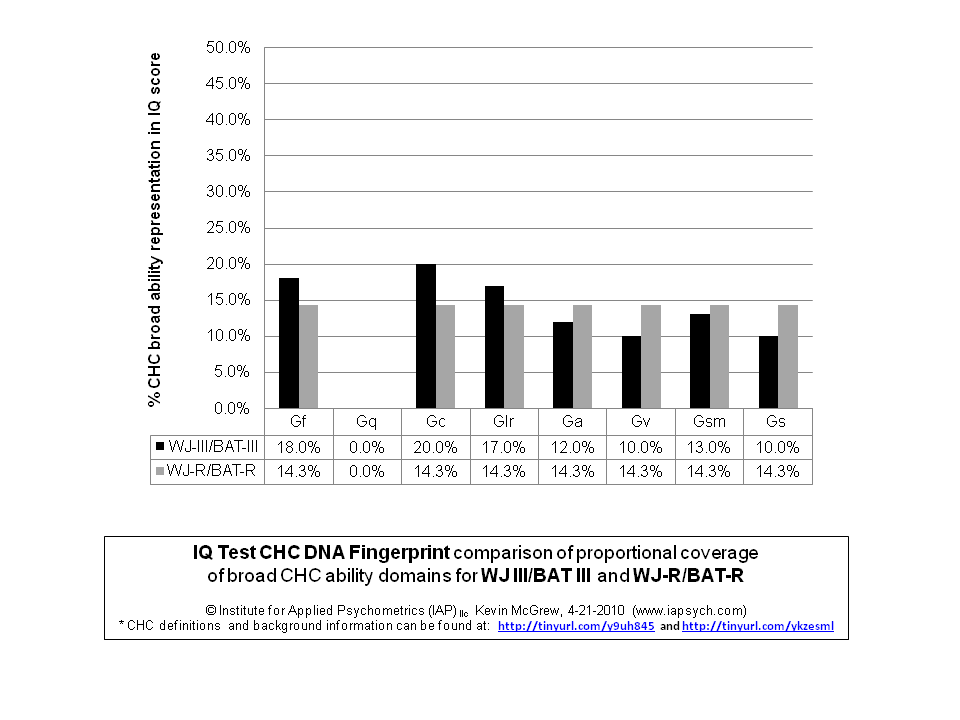
    IQ Test DNA Fingerprints: Comparison of WJ III/BAT III to WJ-R/BAT-R

    Here is another of IQ's Corner "IQ Test CHC DNA Fingerprint" test comparison series.  This particular CHC fingerprint figure compares the CHC composition of the respective full scale total composite IQ scores from the WJ III/BAT III and the the earlier version of these batteries....the WJ-R/BAT-R.

    Background information regarding the development, use and interpretation of this IQ global IQ score feature can be found at a prior post and in the IQ Test CHC DNA Fingerprint section on the blog side bar.

    I now present a comparison of the R/III versions of the WJ/BAT batteries as I have seen psych reports where a subject had previously been administered the WJ-R and was later tested with the revised WJ III (in the case of Spanish-speaking individuals, I've seen the BAT-R and the BAT-III---click here for more background information on the Spanish version of the WJ III...the BAT III).  

    In the case of the WJ-R/BAT-R, the full scale IQ composite is called the Broad Cognitive Ability (BCA) cluster.  The name was changed in the WJ III/BAT III to General Intellectual Ability (GIA) cluster.  The name change was not cosmetic.  The use of the term "general intellectual ability" in the newest WJ III/BAT III reflects the fact that this global IQ composite score is designed to be the best statistical estimate of the theoretical construct of general intelligence (g) via the use of differential test weights.

    Using principal components analysis, a g-factor was extracted from the seven WJ III/BAT III Standard Cognitive battery tests (at each age level), g-factor weights calculated (by age---they shift slightly as a function of age), and the g-weights used to differentially weight the contribution of the seven tests to the composite GIA-Standard cluster score.  The same process was completed for the 14 test GIA-Extended cluster score.  This procedure is explained in detail in the WJ III/BAT III technical manuals/reports and is also briefly summarized in a free on-line Assessment Service Bulletin technical abstract.

    In the case of the WJ-R/BAT-R, the respective 7-test BCA-Standard and 14-test BCA-Extended cluster scores are based on the simple arithmetic average of each set of scores, thus resulting in an equally weighted global IQ score.

    Thus, differences between the global WJ-R/BAT-R and WJ III/BAT III IQ scores may occur as a function of the respective scores reflecting differential contributions of the broad Gf-Gc abilities as per the CHC theoretical model that underlies the batteries.

    Below is the IQ Test CHC DNA Fingerprint comparison of the two respective editions of the WJ-R/BAT-R and WJ III/BAT III.  The weights presented for the WJ III/BAT III are the median (average) weights across all age groups.  The previously referenced ASB (see above) includes a table of the specific weights by age.

    [double click on figure to enlarge]

    Although the CHC composition of the respective global IQ scores did not change dramatically, there are enough differences by CHC ability to suggest that slightly different global IQ scores may be produced for the same individual depending on whether they took the WJ-R/BAT-R or the WJ III/BAT III (assuming proper administration, scoring, etc.).  Consistent with psychometric intelligence theory (aka., CHC theory), the WJ III/BAT III global IQ scores (GIA-Stnd; GIA-Ext) are more heavily weighted as per a subjects performance on the more g-loaded measures of Gf (fluid intelligence/reasoning), Gc (crystallized intelligence or comprehension-knowledge), and Glr (long-term storage and retrieval).  In contrast, abilities that are less cognitively demanding and more related to perceptual (Gv, Ga), speed (Gs), and short-term memory (Gsm) functioning contribute slightly less to an individuals WJ III/BAT III global IQ GIA score than was the case with the WJ-R/BAT-R.

    If significant differences are found when comparing scores from the respective R/III editions of the WJ for an individual, examiners should review the Gf-Gc CHC test/cluster profiles to determine if some (or all) of the score differences might be related to the shift from an equally weighted global IQ score (WJ-R/BAT-R) to a differentially-weighted (WJ III/BAT III) global IQ score.  In theory, an individual could obtain very similar test-level scores on each battery, but because "all scores are not created equal" (in the estimation of general intelligence or g) in the case of the WJ III, a shift in the global GIA IQ scores may occur.

    Other IQ Test CHC DNA Fingerprint comparisons can be found by clicking here.  More will be coming in the future.

    [Conflict of interest note:  I am a co-author of the WJ III/BAT III]

    Technorati Tags: , , , , , , , , , , , , , , , , , , , , , , , , , , , , , , , , , ,

    Monday, April 19, 2010

    AAIDD June conference sessions relevant to ID/MR Dx and Atkins death penalty cases

    A number of AAIDD conferences sessions/workshops related to ID/MR Dx and Atkins MR/ID Death Penalty cases.

    Death Penalty Session - Wednesday June 9

    Atkins v. Virginia : Challenges and Pitfalls in Diagnosing ID in a Forensic Context

    Moderator:      Marc J. Tassé, The Ohio State University Nisonger Center

    A Quantitative and Qualitative Analysis of Post-Atkins Decisions by Juries and Judges
    John H. Blume, Cornell Law School

    Assessing Intellectual Functioning
    Kevin S. McGrew, Institute for Applied Psychometrics

    Assessing Adaptive Behavior in a Forensic Context
    James R, Patton, University of Texas at Austin

    Assessment of Malingering
    Denis William Keyes, College Of Charleston

    Retrospective Diagnosis
    Sal Blandino, Licensed Psychologist

    Closing Commentary
    Stephen Greenspan, University of Colorado at Denve

    Workshops--Friday June 11

    Workshop #1:

    Evaluations and Expert Testimony in Criminal Cases
    James Ellis, UNM School of Law, University of NM
    Disability professionals are increasingly called upon to provide evaluations and expert testimony in criminal cases, particularly in Atkins cases where the defendant's intellectual disability is at issue. Participating in these life-and-death proceedings can be a daunting prospect. This workshop will include explanation of the criminal law issues involved, diagnostic and classification issues under the new AAIDD (11th edition) manual, and practical suggestions from disability professionals who have participated in these cases.

    Workshop #2

    Understanding and Using the 11th Edition of Intellectual Disability: Definition, Classification, and Systems of Supports
    Bob Schalock, PhD, Ruth Luckasson, JD, Wil Buntinx, PhD, Pat Craig, PhD, Alya Reeve, MD, Karrie Shogren, PhD, Marc Tasse, PhD, Jim Thompson, PhD
    11th Edition Implementation Committee members will present and discuss in detail key issues in the field related to diagnosis, classification, and supports planning. As a basis for maximum interaction and problem solving, workshop participants will be required to bring or purchase a copy of the 11th edition of the Manual. The workshop format will involve presentations, interactions, and opportunities to problem solve.

    Technorati Tags: , , , , , , , , , , , , , , , , , , , , , , , , , , ,

    Atkins MR/ID Death Penalty listserv update 4-19-10

    FYI update. The public Atkins MR/ID death penalty listserv now his 40 members. Welcome.  Also, thanks to those who have spread the word in and who have started to participate in some of the initial discussions.

    Hopefully this is just the beginning of an effective tool for the exchange of scientifically accepted and professionally recognized information related to Atkins MR/ID cases.

    Technorati Tags: , , , , , , , , , , , , , , , , , , , , , , , , , , ,

    ICDP status update 4-19-10: Thank you and welcome new visitors

    Below are the hit counter stats for the ICDP blog.  The numbers are encouraging. It is nice to see the number of new visitors. Thanks to all who have spread the word and continue support the blogmaster's efforts via private e-mails, sharing of articles and court decisions, etc.


    Site: "Intellectual Competence & Death Penalty"
    Last week:
    
    Hits:         907
    Hosts:        416
    Visitors:     486
    Sessions:     550
    New Visitors: 340

    Saturday, April 17, 2010

    iPost: ID decisions and elections of judges

    Interesting (troubling?) story of a judges decision in an Atkins case
    being used as negative campaign information in an election of judges.

    A good example why judges should be appointed and no elected -- my
    opinion as the blogmaster. Story at link below.


    http://www.tribtoday.com/page/content.detail/id/536073.html?nav=5021


    Sent from KMcGrew iPhone (IQMobile). (If message includes an image-
    double click on it to make larger-if hard to see)

    iPost: SCOTUS "Sounds of silence"

    Story at BLT blog link below

    http://legaltimes.typepad.com/blt/2010/04/at-the-supreme-court-the-sound-of-silence-times-seven.html


    Sent from KMcGrew iPhone (IQMobile). (If message includes an image-
    double click on it to make larger-if hard to see)

    iPost: Does who you kill impact probability of death penalty?

    Link at DPIC URL below

    http://www.deathpenaltyinfo.org/studies-victims-social-status-plays-influential-role-death-cases


    Sent from KMcGrew iPhone (IQMobile). (If message includes an image-
    double click on it to make larger-if hard to see)

    iPost: Neuroscience and law: The "continuum" problem

    Interesting food for thought at the NEUROETHICS AND LAW blog link below


    http://kolber.typepad.com/ethics_law_blog/2010/04/felicity-grisham-on-the-problem-of-the-continuum.html


    Sent from KMcGrew iPhone (IQMobile). (If message includes an image-
    double click on it to make larger-if hard to see)

    Friday, April 16, 2010

    iPost: Fall 2009 death row report

    Report at link below

    http://www.deathpenaltyinfo.org/new-resources-death-row-usa-fall-2009


    Sent from KMcGrew iPhone (IQMobile). (If message includes an image-
    double click on it to make larger-if hard to see)