Showing posts with label WJ-R. Show all posts

Thursday, October 15, 2015

Evolution of the WJ to WJ IV GIA and CHC clusters


Click on image to enlarge.

Long-time users of the various editions of the WJ cognitive battery (WJ, WJ-R, WJ III, WJ IV) know that the battery has continued to evolve over time.  Above  is a portion of a large table that summarizes the same and different tests included in the GIA (g-score) and broad CHC clusters across editions.  The complete table demonstrates that the WJ has not remained static, with each new edition evolving as per research and theory.  

The practical benefit of the complete table comes when examiners want to compare scores from  similarly named cluster scores across different editions of the WJ--different scores may be due, in part, to different mixtures of tests in  clusters across editions.  I hope this is helpful. 

The complete table can be downloaded here.  The table is adapted from a similar table in
Cormier, D., McGrew, K., Bulut, O., Funamoto, A. (2015).  Exploring the relationships between broad Cattell-Horn-Carroll (CHC) cognitive abilities and reading achievement during the school-age years, Manuscript submitted for publication.

Thursday, December 2, 2010

IQ test battery publication timeline: Atkins MR/ID Flynn Effect cheat sheet

As I've become involved in consulting on Atkins MR/ID death penalty cases, a frequent topic raised is that of norm obsolescence (aka, the Flynn Effect). When talking with others I often have trouble spitting out the exact date of publication of the various revisions of tests, as I keep track of more than just the Wechsler batteries (which are the primary IQ tests in Atkins reports). I often wonder if others question my expertise...but most don't realize that there are more IQ batteries out there than just the Wechsler adult battery....and, in particular, a large number of child normed batteries and other batteries spanning childhood and adulthood. Thus, I decided to put together a cheat sheet for myself..one that I could print and have in my files. I put it together in the form of a simple IQ battery publication timeline. Below is an image of the figure. Double click on it to enlarge.

An important point to understand is that when serious discussions start focusing on the Flynn effect in trial's, most often the test publication date is NOT used in the calculation of how obsolete a set of test norms are. Instead, the best estimate of the year the test was normed/standardized is used, which is not included in this figure (you will need to locate this information). For example, the WAIS-R was published in 1981...but the manual states that the norming occurred from May 1976 to May 1980. Thus, in most Flynn effect discussions in court cases, the date of 1978 (middle of the norming period) is typically used. This makes recall of this information difficult for experts who track all the major individually administered IQ batteries.

Hope this helpful...if nothing else...you must admit that it is pretty :)  Click on image to view.


- iPost using BlogPress from my Kevin McGrew's iPad

Friday, July 16, 2010

Cattell-Horn-Carroll (CHC) based intelligence testing in Atkins cases

I've written frequently about the importance of psychologists involved in Atkins cases to get more up-to-date re: contemporary psychometric intelligence theory, especial the consensus Cattell-Horn-Carroll (CHC) theory of intelligence (click here for all prior posts, this one included, so tagged at the ICDP blog).  The gap between contemporary intelligence theory and testing practice in legal settings is troubling and needs to be narrowed.

Today I'm excited to announce the availability of a "taking stock" intelligence test/theory article that supports my frequent and persistent message...and it is NOT by me...but by other highly respected intelligence test research scholars.

I'm excited to announce that the special issue of Psychology in the Schools, Current Research in Cattell-Horn-Carroll-Based Assessment (guest editors where Jocelyn Newton and myself), is now published.  Yippeee.  To be honest, Dr. Newton deserves the major credit....she did all the heavy lifting and I road her coat tails.  Also thanks to Dr. David McIntosh for suggesting and overseeing the special issue

A review of the TOC can be found by clicking here. 

The article that I highly recommend as must reading is listed below (along with a link to a copy).

Keith, T. & Reynolds, M. (2010).  Cattell-Horn-Carroll abilities and cognitive tests:  What we've learned from 20 years of research.  Psychology in the Schools, 47(4), 2010, 635-650 (also available via click here)
This article reviews factor-analytic research on individually administered intelligence tests from a Cattell-Horn-Carroll (CHC) perspective. Although most new and revised tests of intelligence are based, at least in part, on CHC theory, earlier versions generally were not. Our review suggests that whether or not they were based on CHC theory, the factors derived from both new and previous versions of most tests are well explained by the theory. Especially useful for understanding the theory and tests are cross-battery analyses using multiple measures from multiple instruments. There are issues that need further explanation, of course, about CHC theory and tests derived from that theory. We address a few of these issues including those related to comprehension-knowledge (Gc) and memory factors, as well as issues related to factor retention in factor analysis.
Although the WAIS-IV is not specifically treated in the article, the authors do address the changing (and more CHC-like foundation) of the Wechsler batteries via research on the WISC-III/IV (which the WAIS-IV has been following in terms of structural organization since the WAIS-III/IV).  The inescapable conclusion is that psychologists involved in Atkins cases need to "get current" on CHC theory and CHC-based test interpretation.  It is nice to no longer be the sole voice yelling into the halls of justice.

The article makes reference to a master table of CHC abilities and definitions included in the introduction to this special issue I co-authored with Dr. Newton.  It available here.


Technorati Tags: , , , , , , , , , , , , , , , , , , , , , , , , , , , , , , ,

Wednesday, April 21, 2010

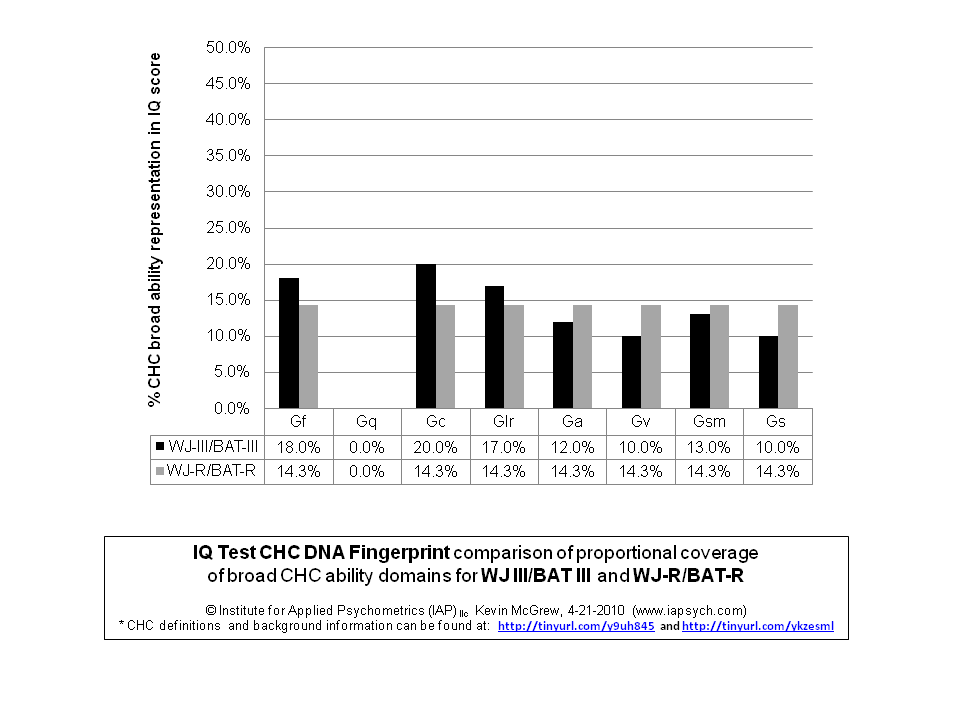
IQ Test DNA Fingerprints: Comparison of WJ III/BAT III to WJ-R/BAT-R

Here is another of IQ's Corner "IQ Test CHC DNA Fingerprint" test comparison series.  This particular CHC fingerprint figure compares the CHC composition of the respective full scale total composite IQ scores from the WJ III/BAT III and the the earlier version of these batteries....the WJ-R/BAT-R.

Background information regarding the development, use and interpretation of this IQ global IQ score feature can be found at a prior post and in the IQ Test CHC DNA Fingerprint section on the blog side bar.

I now present a comparison of the R/III versions of the WJ/BAT batteries as I have seen psych reports where a subject had previously been administered the WJ-R and was later tested with the revised WJ III (in the case of Spanish-speaking individuals, I've seen the BAT-R and the BAT-III---click here for more background information on the Spanish version of the WJ III...the BAT III).  

In the case of the WJ-R/BAT-R, the full scale IQ composite is called the Broad Cognitive Ability (BCA) cluster.  The name was changed in the WJ III/BAT III to General Intellectual Ability (GIA) cluster.  The name change was not cosmetic.  The use of the term "general intellectual ability" in the newest WJ III/BAT III reflects the fact that this global IQ composite score is designed to be the best statistical estimate of the theoretical construct of general intelligence (g) via the use of differential test weights.

Using principal components analysis, a g-factor was extracted from the seven WJ III/BAT III Standard Cognitive battery tests (at each age level), g-factor weights calculated (by age---they shift slightly as a function of age), and the g-weights used to differentially weight the contribution of the seven tests to the composite GIA-Standard cluster score.  The same process was completed for the 14 test GIA-Extended cluster score.  This procedure is explained in detail in the WJ III/BAT III technical manuals/reports and is also briefly summarized in a free on-line Assessment Service Bulletin technical abstract.

In the case of the WJ-R/BAT-R, the respective 7-test BCA-Standard and 14-test BCA-Extended cluster scores are based on the simple arithmetic average of each set of scores, thus resulting in an equally weighted global IQ score.

Thus, differences between the global WJ-R/BAT-R and WJ III/BAT III IQ scores may occur as a function of the respective scores reflecting differential contributions of the broad Gf-Gc abilities as per the CHC theoretical model that underlies the batteries.

Below is the IQ Test CHC DNA Fingerprint comparison of the two respective editions of the WJ-R/BAT-R and WJ III/BAT III.  The weights presented for the WJ III/BAT III are the median (average) weights across all age groups.  The previously referenced ASB (see above) includes a table of the specific weights by age.

[double click on figure to enlarge]

Although the CHC composition of the respective global IQ scores did not change dramatically, there are enough differences by CHC ability to suggest that slightly different global IQ scores may be produced for the same individual depending on whether they took the WJ-R/BAT-R or the WJ III/BAT III (assuming proper administration, scoring, etc.).  Consistent with psychometric intelligence theory (aka., CHC theory), the WJ III/BAT III global IQ scores (GIA-Stnd; GIA-Ext) are more heavily weighted as per a subjects performance on the more g-loaded measures of Gf (fluid intelligence/reasoning), Gc (crystallized intelligence or comprehension-knowledge), and Glr (long-term storage and retrieval).  In contrast, abilities that are less cognitively demanding and more related to perceptual (Gv, Ga), speed (Gs), and short-term memory (Gsm) functioning contribute slightly less to an individuals WJ III/BAT III global IQ GIA score than was the case with the WJ-R/BAT-R.

If significant differences are found when comparing scores from the respective R/III editions of the WJ for an individual, examiners should review the Gf-Gc CHC test/cluster profiles to determine if some (or all) of the score differences might be related to the shift from an equally weighted global IQ score (WJ-R/BAT-R) to a differentially-weighted (WJ III/BAT III) global IQ score.  In theory, an individual could obtain very similar test-level scores on each battery, but because "all scores are not created equal" (in the estimation of general intelligence or g) in the case of the WJ III, a shift in the global GIA IQ scores may occur.

Other IQ Test CHC DNA Fingerprint comparisons can be found by clicking here.  More will be coming in the future.

[Conflict of interest note:  I am a co-author of the WJ III/BAT III]

Technorati Tags: , , , , , , , , , , , , , , , , , , , , , , , , , , , , , , , , , ,

Friday, April 9, 2010

Spanish Woodcock-Johnson Battery III: Bateria III (BAT III) use in ID/MR assessmnet

As a coauthor of the WJ III/BAT III, I've been receiving increasing emails and phone calls for information describing the BAT III and its appropriateness for assessing intelligence in Atkins ID/MR cases.  I do have an obvious conflict of interest as a co-author, but I believe it is is one of the most psychometrically and theoretically sound measures of human intelligence for Spanish-speaking individuals where a Dx of ID/MR is in question.

To save everyone (including me) many e-mails and phone calls, I've decided to post everything I have (in e-form) regarding the BAT III.  In addition, I'm posting information re: the prior edition (BAT-R) as the procedures used to adapt, translate and norm (via US-equated norm procedures) are the same. 

Below are key documents.
I hope people find this information useful.  I will also soon post a comparison of the CHC content of the two batteries (CHC DNA Fingerprint Analysis comparison of BAT-R and BAT III).

Finally, although I have not updated it for over a year, given that the BAT-III is parallel to the WJ III, individuals may want to review available published and unpublished research on the WJ III (and to a lessor extent the BAT III).  This can be found at the WJ III EWOK (v3.0; Evolving Web of Knowledge) at IQs Corner blog.

Technorati Tags: , , , , , , , , , , , , , , , , , , , , , , , , , , , , , , , , ,

Sunday, January 31, 2010

Intellectual heterogeneity of MR/ID as evidence against AAIDD "stuck on g" green manual: Even in cleary genetic-based syndromes (Williams Syndrome)

In the last in my series of posts re: concerns I have with the AAIDD 11th Edition ID definition and classification manual, one  point I raised (re: my concern for the AAIDD "stuck on g" position) was the fact that individuals with ID/MR should not be stereotyped as having a single type of cognitive disability (simply poor g---which also implies, for many, a "flat profile" of cognitive abilities). 

Although not so stated in the AAIDD manual, the elevation of general intelligence to such high status, combined with statements that current intelligence measures are not available to reliably and validly assess multiple cognitive abilities (a statement that is simply wrong--see PPT show link in last post in series), implicitly has the potential to convey this stereotype.  I argued that individuals with ID/MR show just as much heterogeneity in profiles of cognitive abilities as individuals without ID/MR.

This past week a colleague reminded me of one article that makes my point clear.  Within the field of ID/MR, there are a number of rare genetic-based disorders.  Such genetically-based disorders typically result in a greater degree of similarity (homogeneity) among individuals with the condition.  Williams syndrome (WS) is one such ID/MR disorder.  Of course, individuals with WS are not those being evaluated in typical Atkins death penalty cases, but the common assumption and lore is that WS individuals show a "syndrome-specific pattern of cognitive strengths/weaknesses"----high verbal abilities and much lower visual-spatial abilities.

I would argue, as have others, that this WS syndrome-specific cognitive stereotype is largely due to the fact that historically MR/ID researchers only had the V/P organized Wechsler batteries as their primary IQ battery...and that the "profile" may be due to this research being constrained by batteries that did not validly measure a greater breadth of cognitive functioning.  This is not a criticism of the past research, as researchers had limited theories of intelligence and measures of constructs from which to work.  However, now that CHC theory has emerged as the consensus psychometric model of cognitive abilities and, more importantly, there are a significant number of well-standardized and psychometrically sound IQ batteries of multiple cognitive abilities, I'm not surprised that a syndrome with a strong genetic core, which typically results in more within-group similarity, when measured by more contemporary CHC-based IQ batteries display considerable variability/heterogeneity in patterns of cognitive abilities. 

Below is the abstract for  2005 study that reported that WS individuals do NOT display the classic and historical syndrome-specific pattern of cognitive strengths and weaknesses when measured with a more contemporary CHC-based cognitive battery (WJ-R:  conflict of interest note--I am a coauthor of the next edition..the WJ III).

This study clearly suggests that even a population of individuals with a shared genetic causal mechanism display significant individual differences in patterns of cognitive abilities.  If this is found in ID/MR populations with a strong shared genetic causal mechanism, one would be hard-pressed to argue that such variability does not exist for more milder forms of ID/MR and the general population.

My point (again)---I'm very concerned that the AAIDD 11th Edition ID manual's "stuck on g" position is out of synch with contemporary intelligence theory and measurement and has the potential to cause serious harm when potentially life-altering decisions are made on the basis of a single g-based composite IQ scores that ignores the heterogeneity of human cognitive abilities across the ability spectrum and different disorders.

Porter, M. A. & Coltheart, M.  Cognitive Heterogeneity in Williams Syndrome.  Developmental Neuropsychology, 27 (2), 275-306. (click here to view articlehttp://www.iapsych.com/articles/porter2005.pdf


Abstract
This study used the Woodcock-Johnson Tests of Cognitive Ability-Revised to investigate a wide range of cognitive abilities in people with Williams syndrome (WS). It involved a comparatively large sample of 31 people with WS, but took a case-series approach. The study addressed the widespread claims of a characteristic "WS cognitive profile" by looking for heterogeneity rather than homogeneity. People with WS showed a variety of preserved (significantly above mental age [MA]), expected (at MA), and significantly impaired (significantly below MA) levels of functioning. Such results provide clear evidence for heterogeneity in cognitive functions within WS. We found the most homogeneity on a test of phonological processing and a test of phonological short-term memory, with half of the WS sample performing at MA levels on these tests. Interestingly, no WS individual showed a weakness on a test of nonverbal reasoning, and only one WS individual showed a weakness on a test of verbal comprehension. In addition, we found that strengths on analysis-synthesis and verbal analogies occurred only for WS individuals with an MA less than 5.5 years (our sample median MA); people with an MA greater than 5.5 years performed at MA level on these 2 tests. Results also provided preliminary evidence for distinct subgroups of WS people based on their cognitive strengths and weaknesses on a broad range of cognitive functions. On the basis of the findings, caution should be made in declaring a single cognitive profile that is characteristic of all individuals with WS. Just as there is heterogeneity in genetic and physical anomalies within WS, not all WS individuals share the same cognitive strengths and weaknesses. Also, not all WS individuals show the profile of a strength in verbal abilities and a weakness in spatial functions.

Technorati Tags: , , , , , , , , , , , , , , , , , , , , , , , , , , , , ,