Showing posts with label DAS-2. Show all posts

Wednesday, March 2, 2011

Differential Abilities Scales-II IQ test: CHC explanation from publisher

I picked up a nice glossily CHC and DAS-II brochure at the NASP conference last week. It explains, as per the DAS-II author and publisher, how they view the interpretation of the Differential Abilities Scales, Second Edition, from the consensus psychometric model of intelligence (CHC theory).

If anyone can refer me to an on-line PDF copy from the publisher, I will switch out the link to direct traffic to that page. I could not find one when I searched for it.

- iPost using BlogPress from my Kevin McGrew's iPad

Generated by: Tag Generator


Thursday, December 2, 2010

IQ test battery publication timeline: Atkins MR/ID Flynn Effect cheat sheet

As I've become involved in consulting on Atkins MR/ID death penalty cases, a frequent topic raised is that of norm obsolescence (aka, the Flynn Effect). When talking with others I often have trouble spitting out the exact date of publication of the various revisions of tests, as I keep track of more than just the Wechsler batteries (which are the primary IQ tests in Atkins reports). I often wonder if others question my expertise...but most don't realize that there are more IQ batteries out there than just the Wechsler adult battery....and, in particular, a large number of child normed batteries and other batteries spanning childhood and adulthood. Thus, I decided to put together a cheat sheet for myself..one that I could print and have in my files. I put it together in the form of a simple IQ battery publication timeline. Below is an image of the figure. Double click on it to enlarge.

An important point to understand is that when serious discussions start focusing on the Flynn effect in trial's, most often the test publication date is NOT used in the calculation of how obsolete a set of test norms are. Instead, the best estimate of the year the test was normed/standardized is used, which is not included in this figure (you will need to locate this information). For example, the WAIS-R was published in 1981...but the manual states that the norming occurred from May 1976 to May 1980. Thus, in most Flynn effect discussions in court cases, the date of 1978 (middle of the norming period) is typically used. This makes recall of this information difficult for experts who track all the major individually administered IQ batteries.

Hope this helpful...if nothing else...you must admit that it is pretty :)  Click on image to view.


- iPost using BlogPress from my Kevin McGrew's iPad

Friday, July 16, 2010

Cattell-Horn-Carroll (CHC) based intelligence testing in Atkins cases

I've written frequently about the importance of psychologists involved in Atkins cases to get more up-to-date re: contemporary psychometric intelligence theory, especial the consensus Cattell-Horn-Carroll (CHC) theory of intelligence (click here for all prior posts, this one included, so tagged at the ICDP blog).  The gap between contemporary intelligence theory and testing practice in legal settings is troubling and needs to be narrowed.

Today I'm excited to announce the availability of a "taking stock" intelligence test/theory article that supports my frequent and persistent message...and it is NOT by me...but by other highly respected intelligence test research scholars.

I'm excited to announce that the special issue of Psychology in the Schools, Current Research in Cattell-Horn-Carroll-Based Assessment (guest editors where Jocelyn Newton and myself), is now published.  Yippeee.  To be honest, Dr. Newton deserves the major credit....she did all the heavy lifting and I road her coat tails.  Also thanks to Dr. David McIntosh for suggesting and overseeing the special issue

A review of the TOC can be found by clicking here

The article that I highly recommend as must reading is listed below (along with a link to a copy).

Keith, T. & Reynolds, M. (2010).  Cattell-Horn-Carroll abilities and cognitive tests:  What we've learned from 20 years of research.  Psychology in the Schools, 47(4), 2010, 635-650 (also available via click here)
This article reviews factor-analytic research on individually administered intelligence tests from a Cattell-Horn-Carroll (CHC) perspective. Although most new and revised tests of intelligence are based, at least in part, on CHC theory, earlier versions generally were not. Our review suggests that whether or not they were based on CHC theory, the factors derived from both new and previous versions of most tests are well explained by the theory. Especially useful for understanding the theory and tests are cross-battery analyses using multiple measures from multiple instruments. There are issues that need further explanation, of course, about CHC theory and tests derived from that theory. We address a few of these issues including those related to comprehension-knowledge (Gc) and memory factors, as well as issues related to factor retention in factor analysis.
Although the WAIS-IV is not specifically treated in the article, the authors do address the changing (and more CHC-like foundation) of the Wechsler batteries via research on the WISC-III/IV (which the WAIS-IV has been following in terms of structural organization since the WAIS-III/IV).  The inescapable conclusion is that psychologists involved in Atkins cases need to "get current" on CHC theory and CHC-based test interpretation.  It is nice to no longer be the sole voice yelling into the halls of justice.

The article makes reference to a master table of CHC abilities and definitions included in the introduction to this special issue I co-authored with Dr. Newton.  It available here.


Technorati Tags: , , , , , , , , , , , , , , , , , , , , , , , , , , , , , , ,

Tuesday, November 17, 2009

AP101 Brief #2: IQ test battery descriptive comparison information


Although the adult Wechsler intelligence battery (WAIS-R; WAIS-III; WAIS-IV) is the most frequently used intelligence battery in Atkins cases (often called the "gold standard"), other intelligence tests are starting to show up in psychological reports.  These other tests are either newer intelligence batteries (first editions published in the past 30 years), revisions of older batteries (e.g., Stanford-Binet), or are tests reflecting scores from a test taken while a defendent was in school (and the battery only providesnorms for school-age populations).  Over time I will be presenting information that will allow readers to better understand the similarities and differences of these different batteries, with a particular focus on why they may provide different scores.

To kick of this effort, this post presents basic background information re: the most popular comprehensive intelligence batteries,

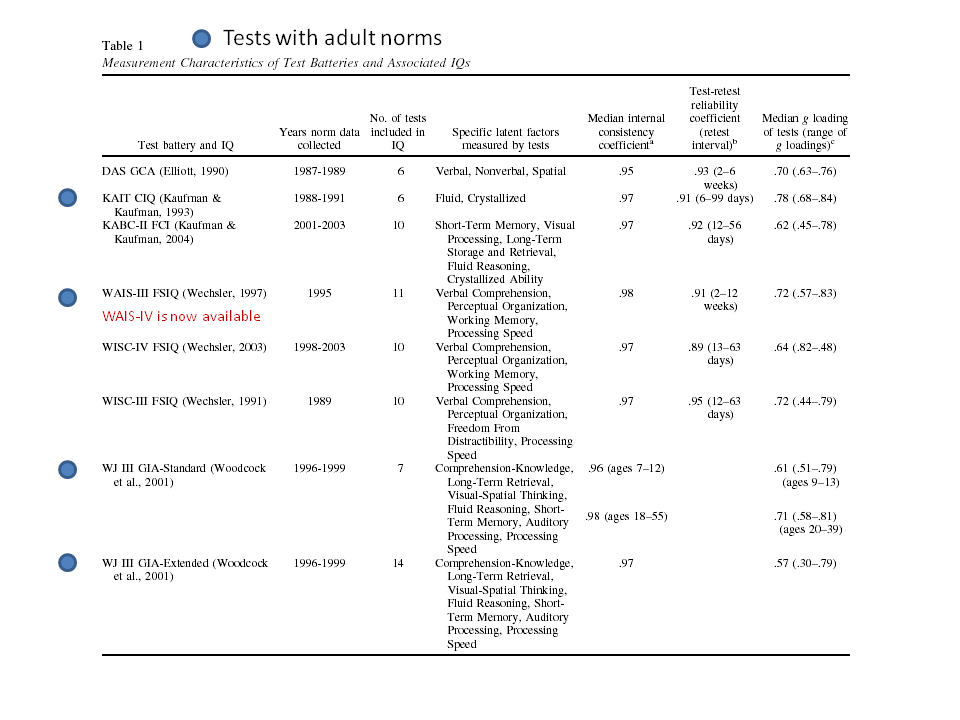
First, as I've mentioned before, in 2002 a national panel of experts made recommendations re: the use of intelligence and adaptive behavior tests in MR/ID eligibility determination (for SSA benefits).  In that publication a table was presented that listed the comprehensive intelligence batteries deemed suitable for MR/ID determination.  The table can be viewed by clicking here.  Only three of the batteries listed at that time had adult norms.  Also, many of the tests have since been revised/renormed--thus making the basic information in the table out-of-date.  The important point is that there are other intelligence tests (beyond the Wechsler "gold standard") that have been deemed appropriate for MR/ID identification/Dx/classifcation by a national panel of experts.

Floyd, Clark and Shadish (2008) reported on the exchangability of full scale IQ scores from most of the major comprehensive intelligence batteries.  In that article they provide an excellent descriptive summary table of the major characteristics of the respective test batteries.  This table is reproduced below...with a few annotations. [Click here for a larger version of the table image - when image appears, click on it to make it bigger].


Finally, the Floyd et al. article makes reference to supplementary material  availbale upon request.  One piece of this supplementary information is a lengthy footnote describing the various full scale IQ scores (which are typically the primary focus in Atkins cases...for good or bad) available from the different IQ batteries.  I've reproduced the footnote (with embedded URL links to the product descripton web page of each respective publisher)--click here to view.

Thats enough for now.  This is just a start in ICDPs attempt to provide comparative information on intelligence test results that may appear in psychological reports reviewed in Atkins cases.

Technorati Tags: , , , , , , , , , , , , , , , , , , ,