Showing posts with label SB5. Show all posts

Monday, May 20, 2013

Stanford-Binet 5 post publication resources: 5-20-13


Stanford Binet 5 Assessment Service Bulletins (info from Riverside Publishing web page)


Monday, April 30, 2012

IAP AP101 Report # 13: Problems with the 1960 and 1986 Stanford-Binet IQ Scores in Atkins MR/ID Death Penalty Cases


Often in Atkins MR/ID death penalty cases historical and contemporary IQ scores are available for review by psychological experts.  In many cases these scores vary markedly.  The courts frequently wrestle with the issue of determining what the best estimate is of the person’s general intelligence.  A review of many Atkins cases often reveals frequent mention of two “gold standard” IQ tests in reports or testimony—namely, the Stanford-Binet and the Wechsler series.

The purpose of this working paper is to alert psychologists and the courts to two little known (but extremely important) dents in the gold standard status of two versions of the Stanford-Binet—the 1960 SB and the 1986 SB IV. If a Flynn effect adjustment is made to scores from a 1960 SB, the norm date used to calculate the magnitude of the Flynn effect should be 1932…not 1960.  If SB IV scores exist in an individual’s records, experts providing opinions regarding the individual’s general level of intelligence should consider: (a) eliminating the score from consideration, (b) not give the score great weight in formulating an opinion, or (c) at a minimum, provide qualifying statements regarding the validity of the SB IV score as required by the Joint Test Standards.

IAP Applied Psychometrics 101 Report # 13 can be downloaded by clicking here.

Wednesday, December 14, 2011

Sunday, December 19, 2010

IQ tests and theory trends: Google Ngram visualizations

This past week I read a very intriguing article in the New York Times about a new data visualization tool offered by Google-- the Google Books Ngram Viewer. I then ran across a legal blog post where someone had investigated trends in different law terms...and I couldn't help myself but to give it a try.

As described by Robert Ambrogi at the legal blog:

"Using data drawn from the millions of books it has digitized covering the years 1500 to 2008, it lets you see and compare the frequency of words and phrases as they were used in books over a span of years or centuries. As Google puts it: “The Ngram Viewer lets you graph and compare phrases from these datasets over time, showing how their usage has waxed and waned over the years.”

I first had to experiment with how the entered terms worked. The terms are case sensitive. I checked each phrase with a variety of permutations to maximum the "hit rate"...and then ran some phrases together to ascertain and compare trends.

Below are my results with a few comments--the data tend to speak for themselves. I found that most of what I searched for did not emerge until after 1940...so that is where each graph starts. It is also important to note that the graphs only go up thru 2008...it would be nice to see the graphs up today

Cool stuff. Double click on each graph to enlarge.


This chart suggests that the cognitive ability domains of Gv (Visual Processing), Ga (Auditory Processing), and Processing Speed (Gs) have become hotter topics than Gf (Fluid Intelligence), Gc (Crystallized Intelligence), Gsm (Short term Memory), and Glr (Long term Retrieval). Interesting.


One very clear observation. Among the non-Wechsler intelligence batteries, the Stanford Binet has dropped dramatically over time, while the "newbies" on the IQ testing block (WJ, DAS, KABC, CAS) have made been the focus of more writing since 1990. Note, "Wechsler Intelligence", when included, is the clear winner across time. I left it out so the trends for the "other" batteries would be more distinct.


As I have written about many times, contemporary Cattell-Horn-Carroll (CHC) intelligence theory has become the consensus theory of intelligence. This interesting graph supports this conclusion, especially from 1997 to 2008. Also, if one clicks on the search term in the summary table, one is taken to a page of the Google books that included the term. Click here to see example for CHC theory.

I think many of the trends noted above are due to emergence of Gf-Gc theory to CHC theory with the publication of the 1989 WJ-R. I've written about this critical theory-to-practice birth period here and here.

- iPost using BlogPress from my Kevin McGrew's iPad

Thursday, December 9, 2010

Research briefs: Factor analysis of SB5 and a neuropsychological test battery

As per usual when I make a research byte/brief post, if anyone would like to read the original article, I can share via email---with the understanding that the article is provided in exchange for a brief guest post about it's contents. :) (contact me at iap@earthlink.net if interested). Also, if figure/images are included in the post, they can usually be made larger by clicking on the image.


Doweling, N. M., Hermann, B., LaRue, A., & Sager, M. A. (2010). Latent Structure and Factorial Invariance of a Neuropsychological Test Battery for the Study of Preclinical Alzheimer's Disease. Neuropsychology, 24(6), 742-756.

Abstract

Objective: To examine the latent structure of a test battery currently being used in a longitudinal study of asymptomatic middle-aged adults with a parental history of Alzheimer's disease (AD) and test the invariance of the factor solution across subgroups defined by selected demographic variables and known genetic risk factors for AD. Method: An exploratory factor analysis (EFA) and a sequence of confirmatory factor analyses (CFA) were conducted on 24 neuropsychological measures selected to provide a comprehensive estimate of cognitive abilities most likely to be affected in preclinical AD. Once the underlying latent model was defined and the structural validity established through model comparisons, a multigroup confirmatory factor analysis model was used to test for factorial invariance across groups. Results: The EFA solution revealed a factor structure consisting of five constructs: verbal ability, visuospatial ability, speed & executive function, working memory, and verbal learning & memory. The CFA models provided support for the hypothesized 5-factor structure. Results indicated factorial invariance of the model across all groups examined. Conclusions: Collectively, the results suggested a relatively strong psychometric basis for using the factor structure in clinical samples that match the characteristics of this cohort. This confirmed an invariant factor structure should prove useful in research aimed to detect the earliest cognitive signature of preclinical AD in similar middle aged cohorts.


Williams, T. H., McIntosh, D. E., Dixon, F., Newton, J. H., & Youman, E. (2010). A CONFIRMATORY FACTOR ANALYSIS OF THE STANFORD-BINET INTELLIGENCE SCALES, FIFTH EDITION, WITH A HIGH-ACHIEVING SAMPLE. Psychology in the Schools, 47(10), 1071-1083.

Abstract

The Stanford–Binet Intelligence Scale, Fifth Edition (SB5), is a recently published, multidimensional measure of intelligence based on Cattell–Horn–Carroll (CHC) theory. The author of the test provides results from confirmatory factor analyses in the technical manual supporting the five-factor structure of the instrument. Other authors have examined this factor structure through EFA using the standardization sample, and have not found evidence of a five-factor model. The purpose of the current study was to examine the internal construct validity of the SB5 using an independent sample of high-functioning students. Participants included 201 high-functioning, third-grade students ranging in age from 8 years, 4 months to 10 years, 11 months. Five models of the SB5 were analyzed using Analysis of Moment Structures (AMOS). Our findings indicated that a hierarchical, four-factor, post-hoc model provided the best fit to the data. Generally, implications for school psychologists include a better understanding of the factor structure of the SB5, especially as it relates to high-achieving children. Directions for future research are also discussed


- iPost using BlogPress from my Kevin McGrew's iPad

Thursday, December 2, 2010

IQ test battery publication timeline: Atkins MR/ID Flynn Effect cheat sheet

As I've become involved in consulting on Atkins MR/ID death penalty cases, a frequent topic raised is that of norm obsolescence (aka, the Flynn Effect). When talking with others I often have trouble spitting out the exact date of publication of the various revisions of tests, as I keep track of more than just the Wechsler batteries (which are the primary IQ tests in Atkins reports). I often wonder if others question my expertise...but most don't realize that there are more IQ batteries out there than just the Wechsler adult battery....and, in particular, a large number of child normed batteries and other batteries spanning childhood and adulthood. Thus, I decided to put together a cheat sheet for myself..one that I could print and have in my files. I put it together in the form of a simple IQ battery publication timeline. Below is an image of the figure. Double click on it to enlarge.

An important point to understand is that when serious discussions start focusing on the Flynn effect in trial's, most often the test publication date is NOT used in the calculation of how obsolete a set of test norms are. Instead, the best estimate of the year the test was normed/standardized is used, which is not included in this figure (you will need to locate this information). For example, the WAIS-R was published in 1981...but the manual states that the norming occurred from May 1976 to May 1980. Thus, in most Flynn effect discussions in court cases, the date of 1978 (middle of the norming period) is typically used. This makes recall of this information difficult for experts who track all the major individually administered IQ batteries.

Hope this helpful...if nothing else...you must admit that it is pretty :)  Click on image to view.


- iPost using BlogPress from my Kevin McGrew's iPad

Tuesday, October 26, 2010

Court Decision: Lewis v Thaler (TX,2010)--an update


An update (without comment) regarding Rickey Lewis case in Texas that was blogged about previously. On 10-19-10 his Atkins motion was denied. Court Decisions blogroll will be updated in the next few days.


- iPost using BlogPress from my Kevin McGrew's iPad

Friday, July 16, 2010

Cattell-Horn-Carroll (CHC) based intelligence testing in Atkins cases

I've written frequently about the importance of psychologists involved in Atkins cases to get more up-to-date re: contemporary psychometric intelligence theory, especial the consensus Cattell-Horn-Carroll (CHC) theory of intelligence (click here for all prior posts, this one included, so tagged at the ICDP blog).  The gap between contemporary intelligence theory and testing practice in legal settings is troubling and needs to be narrowed.

Today I'm excited to announce the availability of a "taking stock" intelligence test/theory article that supports my frequent and persistent message...and it is NOT by me...but by other highly respected intelligence test research scholars.

I'm excited to announce that the special issue of Psychology in the Schools, Current Research in Cattell-Horn-Carroll-Based Assessment (guest editors where Jocelyn Newton and myself), is now published.  Yippeee.  To be honest, Dr. Newton deserves the major credit....she did all the heavy lifting and I road her coat tails.  Also thanks to Dr. David McIntosh for suggesting and overseeing the special issue

A review of the TOC can be found by clicking here. 

The article that I highly recommend as must reading is listed below (along with a link to a copy).

Keith, T. & Reynolds, M. (2010).  Cattell-Horn-Carroll abilities and cognitive tests:  What we've learned from 20 years of research.  Psychology in the Schools, 47(4), 2010, 635-650 (also available via click here)
This article reviews factor-analytic research on individually administered intelligence tests from a Cattell-Horn-Carroll (CHC) perspective. Although most new and revised tests of intelligence are based, at least in part, on CHC theory, earlier versions generally were not. Our review suggests that whether or not they were based on CHC theory, the factors derived from both new and previous versions of most tests are well explained by the theory. Especially useful for understanding the theory and tests are cross-battery analyses using multiple measures from multiple instruments. There are issues that need further explanation, of course, about CHC theory and tests derived from that theory. We address a few of these issues including those related to comprehension-knowledge (Gc) and memory factors, as well as issues related to factor retention in factor analysis.
Although the WAIS-IV is not specifically treated in the article, the authors do address the changing (and more CHC-like foundation) of the Wechsler batteries via research on the WISC-III/IV (which the WAIS-IV has been following in terms of structural organization since the WAIS-III/IV).  The inescapable conclusion is that psychologists involved in Atkins cases need to "get current" on CHC theory and CHC-based test interpretation.  It is nice to no longer be the sole voice yelling into the halls of justice.

The article makes reference to a master table of CHC abilities and definitions included in the introduction to this special issue I co-authored with Dr. Newton.  It available here.


Technorati Tags: , , , , , , , , , , , , , , , , , , , , , , , , , , , , , , ,

Tuesday, November 17, 2009

AP101 Brief #2: IQ test battery descriptive comparison information


Although the adult Wechsler intelligence battery (WAIS-R; WAIS-III; WAIS-IV) is the most frequently used intelligence battery in Atkins cases (often called the "gold standard"), other intelligence tests are starting to show up in psychological reports.  These other tests are either newer intelligence batteries (first editions published in the past 30 years), revisions of older batteries (e.g., Stanford-Binet), or are tests reflecting scores from a test taken while a defendent was in school (and the battery only providesnorms for school-age populations).  Over time I will be presenting information that will allow readers to better understand the similarities and differences of these different batteries, with a particular focus on why they may provide different scores.

To kick of this effort, this post presents basic background information re: the most popular comprehensive intelligence batteries,

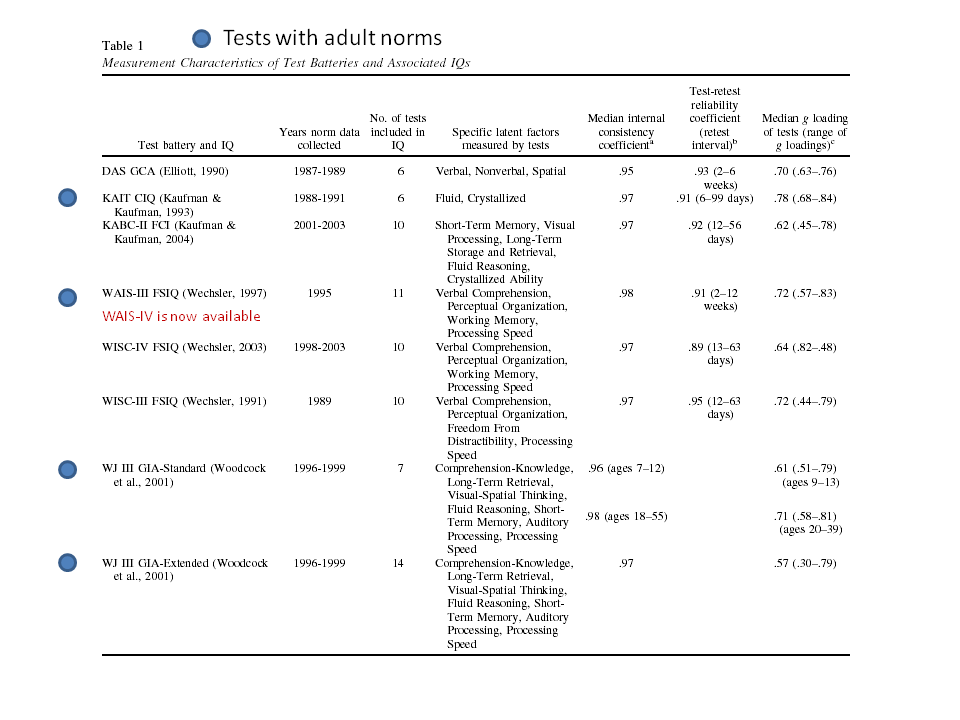
First, as I've mentioned before, in 2002 a national panel of experts made recommendations re: the use of intelligence and adaptive behavior tests in MR/ID eligibility determination (for SSA benefits).  In that publication a table was presented that listed the comprehensive intelligence batteries deemed suitable for MR/ID determination.  The table can be viewed by clicking here.  Only three of the batteries listed at that time had adult norms.  Also, many of the tests have since been revised/renormed--thus making the basic information in the table out-of-date.  The important point is that there are other intelligence tests (beyond the Wechsler "gold standard") that have been deemed appropriate for MR/ID identification/Dx/classifcation by a national panel of experts.

Floyd, Clark and Shadish (2008) reported on the exchangability of full scale IQ scores from most of the major comprehensive intelligence batteries.  In that article they provide an excellent descriptive summary table of the major characteristics of the respective test batteries.  This table is reproduced below...with a few annotations. [Click here for a larger version of the table image - when image appears, click on it to make it bigger].


Finally, the Floyd et al. article makes reference to supplementary material  availbale upon request.  One piece of this supplementary information is a lengthy footnote describing the various full scale IQ scores (which are typically the primary focus in Atkins cases...for good or bad) available from the different IQ batteries.  I've reproduced the footnote (with embedded URL links to the product descripton web page of each respective publisher)--click here to view.

Thats enough for now.  This is just a start in ICDPs attempt to provide comparative information on intelligence test results that may appear in psychological reports reviewed in Atkins cases.

Technorati Tags: , , , , , , , , , , , , , , , , , , ,


Wednesday, October 28, 2009

Lewis v Quarterman (Texas, 2008): Improper test administration and the role of IQ test authors in Atkins cases


The failure of a psychological examiner to follow an IQ tests standardized testing procedures in an Atkins case.  The role of expert testimony by the author of the IQ test in question.  A couple new wrinkles in another Atkins decision.  Lewis v Quarterman (Texas, 2008) has been added to the Court Decisions section of ICDP.  I'd like to thank Kevin Foley, a regular guest blogger at ICDP for the tip on this decision.

In Lewis (2008), the primary issue was the first prong of the MR determination---level of general intellectual functioning.  Lewis had been tested three times (of course, with the traditional adult WAIS-III battery), but his most recent IQ score was based on the Stanford-Binet Fifth Edition (SB5; SB-V), a battery based on the contemporary CHC theory of cognitive abilities.  Lewis had full scale scores of 59 (WAIS-III),70 and 79.  The later score (SB5 score of 79) was the major point of contention in this decision.  Although it is not atypical for attorneys representing either side in Atkins cases to raise challenges about proper administration and scoring of an IQ test, what is unique (in this case) is the filing of an affidavit (by the defense) by the author of the SB V (Dr. Gale Roid).  Asking authors of the IQ tests to provide expert input is not the norm in Atkins cases, and does take the issue of proper test administration and scoring to a higher level.

Before proceeding, I should reveal that I am a colleague of Dr. Roids and was initially on the revision team for the SB V (check out acknowledgments section).  I did not continue on the project as the revision of the WJ III was ramping up (I'm a coauthor) and I did not have sufficient time to work on both.  There is a small fraternity/sorority of applied psychometricians who specialize in developing or revising individualized intelligence tests.  Dr. Roid is one.  I have tremendous respect for his psychometric skills and professional integrity.  Also, by way of background, my interest in starting the ICDP blog originated when I was asked to do the same, but for the battery I am a coauthor (WJ III/BAT III).  I did not review taped test administration but was asked to check the scoring and correct use of the computer scoring and proper norms.  I will eventually make a post about this experience in the context of the issues of test administration and scoring errors. 

It is my professional belief that some (but not all) test authors can provide an important external validity check re: questions raised about proper test administration and scoring of the tests they develop.  This is my professional opinion as a coauthor of an individually administered cognitive and achievement test battery.   However, in many cases it is not possible to identify a single author that can serve as an expert for a test that may be used in court proceedings.  Some IQ tests have multiple authors on the team, each responsible for different (and sometimes overlapping) parts of the tests construction, norming, and statistical analysis.  In other cases a test author may be an professional with a strong publication background and solid theoretical knowledge, but it is the internal staff at the test's publisher that do the major test construction, norming, and psychometric analysis....the publishers internal psychometric staff may know more about the technical aspects of a test (that would benefit the court) than a particular author. 

There is only a handuful (I can count them on one hand) of intelligence test authors who are involved in all aspects of the development of the test (inclusive of the psychometric analysis and development of the test score norms) and who can provide valuable, objective, external expert information to the courts.  Also, some authors may have contractual limitations with a publisher that prohibit them from testifying about the test in legal proceedings.  All this being said, it is my professional belief that  authors that are appropriately and uniquely qualified (e.g., Dr. Gale Roid) can provide valuable input to courts regading testing issues related to their test.  Professionally I believe I have these qualifications related to the WJ III system of instruments and intelligence test development and psychometrics in general.  But let’s get back to the Lewis decision.

The SB5 score of 79 was the primary point of argument in the Lewis decision.  As often happens in these cases, when IQ testing is conducted, the testing is often taped.  This allows for state and/or defense experts to review the IQ testing for the appropriate use of standardized testing procedures (as spelled out by the tests manuals) and possible scoring errors.  A defense expert (not Dr. Roid) had “re-scored” the SB5 and came up with an adjusted score of 75, based on the judgment that errors were made in administration in scoring.

Dr Roid concluded that the original administration and scoring of the SB5 was improper as it included "nine procedural errors"--errors that significantly invalidated the resultant score. According to the decision:
Dr. Roid is the author of the Stanford-Binet IQ test administered to Lewis by Dr. Rosin. Dr. Roid reviewed Dr. Rosin's testimony, notes from, and video recordings of, Dr. Rosin's administration of the IQ test to Lewis, and the test results. The conclusions detailed in Dr. Roid’s affidavit were: administration of the test to Lewis was invalid because standardized procedures were not followed, making the use of the published norms questionable; and, the effect of assistance given by Dr. Rosin to Lewis during the IQ test administration would result in an inflated IQ estimate.

Of particular interest for this blog post, is the fact that the appellate courts oral arguments re: the SB5 test administration and scoring are available for all to hear.  I found the discussion by the very involved panel and lawyers insightful as they struggled to understand psychometric concepts in their own language and vocabulary.  The oral argument can be accessed at the court's argument page [follow the link and type in the docket number - 07-70024 -  in the space provided].  Or, a copy of the MP3 file can be downloaded by clicking here [warning...it is a large file]

Some quotes from the taped oral argument that struck me where:

  • "Outlier" IQ of 79
  • “variances from protocol” --- which meant failure to follow the SB5’s standardized test administration procedures
  • "infected the score" --- which was a panel member’s way of communicating that a score had been invalidated
  • "dumbed it down" --- a quote referencing the fact that the examiner did not follow the standard directions for a working memory test via not requiring the essential task demand of the working memory test (active manipulation of stimuli while being held in working memory)---thus changing the construct being measured.  The test was now measuring an easier aspect of short-term memory.
What I found particularly disturbing (in the oral argument) was the mention of the argument (made by the psychologist who had originally administered the SB5)  that the standard error of measurement (SEM) accounted for any procedural errors made.  Yes, SEM does reflect some variance in scores due to scoring errors, but cannot be a shield to hide behind when multiple standardized procedural errors are made---particularly if certain procedural errors result in significant raw score changes that invalidate ("infect") the final score.  Carried to its logical extreme, any psychologist could make their own idiosyncratic adjustments to a tests standardized testing procedures and claim that the standard error of measurement confidence band would still include the person's "true" IQ score.  As someone who has (a) administered over 1,000 IQ tests during my career, (b) developed standardized intelligence tests, and (c) trained individuals in standardized testing procedures, I'm concerned  the concept of SEM might be abused to hide improper methods that invalidate test scores.  As I learned during my graduate level intelligence testing course, there are only two ways to give a standardized test --- word-for-word or verbatim!  Of course, all well trained examiners are familiar with the accepted practice of "testing the limits" procedures, but that is a topic for another day.

In my opinion, the decision of the appeals court was correct.  They got it right.  They vacated and remanded the original district court decision---telling the district court judge to "go back to the drawing board."

I would urge psychologists who engage in intelligence testing to listen to the oral arguments...to be the mouse in the corner and hear how legal professionals grapple with IQ testing and psychometric concepts.  It is very interesting.  Also, this decision, as well as others I've read, suggest the need for future blog posts that more precisely define the psychometric concepts of the standard error of measurement (SEM) and standardized testing procedures.  I will work on those in the near future.


Technorati Tags: , , , , , , , , , , , , , , , , , , , , ,


Friday, October 23, 2009

IQ practice effect implications for Atkins MR death penalty cases

What are the implications of repeated testing with the same IQ test (practice effects) for Atkins MR related death penalty decisions?

I've been asked this question a number of times but have not had time to search the literature.  Today a generous IQDP reader (Saor Stettler; attorney in CA) sent me a link and PDF copy of a recent review article in the Open Access Journal of Forensic Psychology (click here for PDF copy of the web article).  It looks like a decent review of the literature related to a number of common instruments.  I know there is a pletheor a research on IQ practice effects.  This article might be a good starting point, particularly since it is written in the context of Atkins cases. Below is the citation and abstract.

Thanks to Mr. Stettler for sending this info.  I encourage other readers to sent me links, copies of articles, copies of Atkins decisions, etc.  There is much information available and only so much time to locate it.

Ray, C. L. (2009).  Ethical Implications of Practice Effects on Mental Retardation Claims in Capital Cases.  Open Access Journal of Forensic Psychology, Vol (1).
Using the same intelligence test for multiple examinations of a defendant in a capital case can result in practice effects.  Strict numerical IQ cutoffs are used in some states to determine whether or not a person is considered mentally retarded.  The practice effects of several intelligence tests are reviewed.  Findings are presented regarding practice effects for performance versus verbal items on intelligence tests.  The importance of time frames, IQ, frequency of re-evaluation, and age with respect to practice effects are examined.  Recommendations are discussed concerning the use of intelligence tests in capital cases.


Technorati Tags: , , , , , , , , , , , , , , , , , , , , , , , , ,


Friday, October 16, 2009

More on the use of part IQ scores: Judge playing psychologist (Guest post by Kevin Foley)

In response to the posting of the J. Williams (2007, Texas) Atkins ruling, Kevin Foley has provided the following guest blog comment.  As noted in original posting of the courts decision, I will be making additional comments in future posts.


Dr. McGrew provided two thought provoking postings on the use of partial IQ scores in the Atkins context. But the problem with inappropriate use of partial IQ scores does not lie solely with expert witnesses. The J. Williams (2007, Texas) Atkins case involves a judge’s use of partial IQ scores, without any suggestion by the experts that this was an appropriate way to deal with the Atkins claimant’s IQ scores.  In Jeffrey Demond Williams’ case, the federal magistrate judge court concluded that the partial IQ scores should control over the full scale IQ scores, with no explanation of why (and under what authority) these partial IQ scores should be used as the measure of general intellectual functioning.  Williams had taken three IQ tests, with full scale IQ scores of 70, 70, and 71, all consistent with a diagnosis of mental retardation. To deal with these scores, the magistrate judge stated, “While those three scores appear superficially to show a consistent subaverage intellectual functioning over time, a closer examination reveals that Williams was capable of scoring a Verbal IQ of 79 and a Performance IQ of 77, well outside the mentally retarded range.” [1] The court concluded its decision by stating that, “Considering Williams’ borderline IQ scores in light of his academic performance . . . ,” signifying that it had, in fact, used the partial scores which were in the borderline range (77 and 79) instead of the full scale IQ scores.

Interestingly, even though the magistrate judge sided with the prosecution expert in the end, according to the decision, the prosecution’s expert did not suggest that the judge should use the partial IQ scores of 77 and 79.  The prosecution expert testified that “Williams’ three IQ scores at or near 70 are the result of poor effort on all three tests.” [2] Moreover, this expert’s report filed with the court made no such recommendation. Instead, the state’s expert suggested that a score of 83 on a non-verbal IQ test (TONI-3) given to Williams by the Texas Department of Corrections was the best indicator of Williams intellectual functioning. [3]

So what we have is a magistrate judge playing psychologist and determining on his own that the partial IQ scores were the best indication of Williams intellectual functioning, without any analysis or citation to authority, legal or scientific, to support his conclusion in this regard.  The magistrate’s opinion was adopted by the district court judge, and her findings were affirmed on appeal.  The appeals court compounded the error by approving this approach.

[1] Memorandum and Recommendation, Williams v. Quarterman, Civil Case No. H-04-2945 (S.D. Tex. filed Jan. 8, 2007), at page 70-71.  Even if the court ultimately made the correct decision – that Williams was not mentally retarded - that does not excuse this inappropriate manner of dealing with the three IQ scores.  This especially so in a case like this one, where the magistrate judge admitted that, “reasonable jurists can disagree about whether the evidence supports Williams’ claim that he is mentally retarded.”  Id. at 77. In close cases, the courts need to especially vigilant to ensure that their analysis is both legally and scientifically sound.

[2] Id. at  68.

[3] Psychological Report of Thomas G. Allen, Ph.D., in the matter of  Williams v. Dretke, Civil Case No. H-04-2945,  (Feb. 8, 2006)


Technorati Tags: , , , , , , , , , , , , , , , , , , , ,


J. Williams (2007, Texas) IQ MR Atkins death penalty decision posted: Many issues raised

Another interesting Atkins court decision has been posted to the court decisions section of this blog.  Jeffrey Williams (Williams v Quarterman, Texas, 2007).  Augmenting this court decision is a copy of a psychological report included in the decision.  An initial read of the decision and the psychological report raises a number of interesting questions and issues, such as:


  • The apparent role of a judge becoming the psychometric expert when she decides which part score (verbal, nonverbal, full scale) to use to establish Williams level of intellectual functioning.  Kevin Foley has provided a guest post about this issue, which will be the next post at this blog.
  • The continued issue of part vs full scale IQ scores in Atkins cases. 
  • The role of  school records and school special education decisions made during elementary and secondary schooling in Atkins decisions.
  • The role of measured academic achievement in Atkins decisions, particularly the issue of whether a person who may be mentally retarded can achieve above their measured IQ (note - I've written about this previously and will make comments with appropriate links in a separate post..the answer is "yes").
  • The conceptually and technically messy issue of determining pre-incarceration levels of adaptive behavior retrospectively.  I'm hoping that a few experts in Atkins AB assessment will review the documents and weigh in on the information provided, expert opinions, and final decision.  This area is a definite methodological quagmire in Atkins cases. 
  • The whole issue of malingering and how to detect it
I will be making my own follow-up comments regarding some of these issues in the near future.

Technorati Tags: , , , , , , , , , , , , , , , , , , , ,