Here is another of
IQ's Corner "IQ Test CHC DNA Fingerprint" test comparison series. This particular
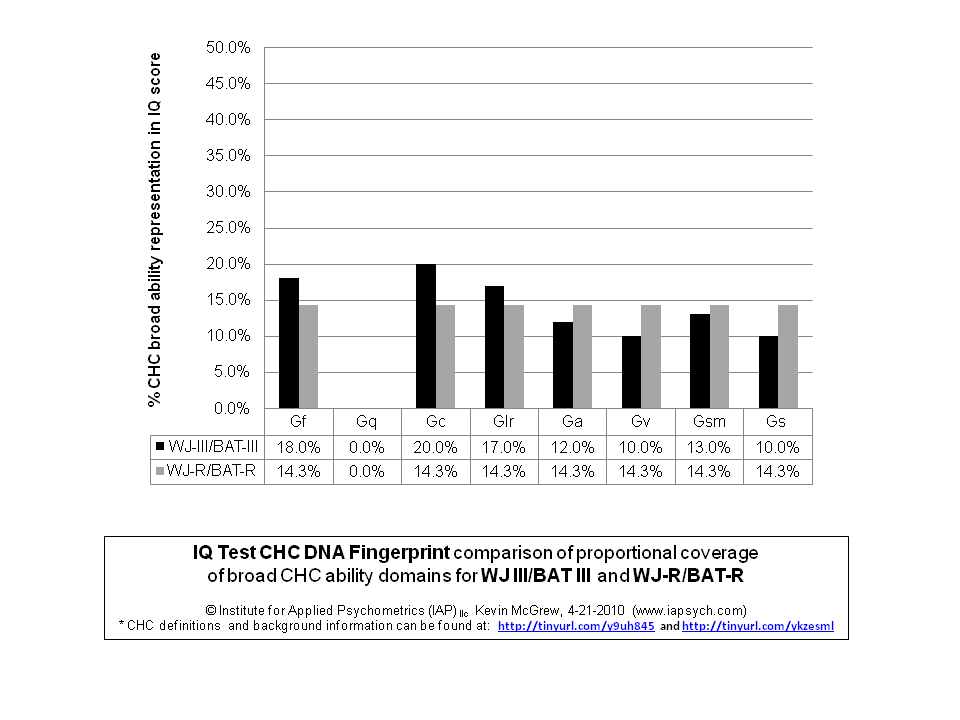
CHC fingerprint figure compares the CHC composition of the respective full scale total composite IQ scores from the
WJ III/BAT III and the the earlier version of these batteries....the
WJ-R/BAT-R.
Background information regarding the development, use and interpretation of this IQ global IQ score feature can be found at a
prior post and in the
IQ Test CHC DNA Fingerprint section on the blog side bar.
I now present a comparison of the
R/III versions of the
WJ/BAT batteries as I have seen psych reports where a subject had previously been administered the
WJ-R and was later tested with the revised
WJ III (in the case of Spanish-speaking individuals, I've seen the
BAT-R and the
BAT-III---
click here for more background information on the Spanish version of the WJ III...the BAT III).
In the case of the
WJ-R/BAT-R, the full scale IQ composite is called the
Broad Cognitive Ability (BCA) cluster. The name was changed in the
WJ III/BAT III to
General Intellectual Ability (GIA) cluster. The name change was not cosmetic. The use of the term "
general intellectual ability" in the newest
WJ III/BAT III reflects the fact that this global IQ composite score is designed to be the best statistical estimate of the theoretical construct of general intelligence (
g) via the use of differential test weights.
Using
principal components analysis, a
g-factor was extracted from the seven
WJ III/BAT III Standard Cognitive battery tests (at each age level),
g-factor weights calculated (by age---they shift slightly as a function of age), and the
g-weights used to
differentially weight the contribution of the seven tests to the composite GIA-Standard cluster score. The same process was completed for the 14 test GIA-Extended cluster score. This procedure is explained in detail in the
WJ III/BAT III technical manuals/reports and is also briefly summarized in a free on-line
Assessment Service Bulletin technical abstract.
In the case of the
WJ-R/BAT-R, the respective 7-test BCA-Standard and 14-test BCA-Extended cluster scores are based on the simple arithmetic average of each set of scores, thus resulting in an
equally weighted global IQ score.
Thus, differences between the global
WJ-R/BAT-R and
WJ III/BAT III IQ scores may occur as a function of the respective scores reflecting differential contributions of the broad Gf-Gc abilities as per the
CHC theoretical model that underlies the batteries.
Below is the
IQ Test CHC DNA Fingerprint comparison of the two respective editions of the
WJ-R/BAT-R and
WJ III/BAT III. The weights presented for the
WJ III/BAT III are the median (average) weights across all age groups. The previously referenced
ASB (see above) includes a table of the specific weights by age.
[double click on figure to enlarge]
Although the CHC composition of the respective global IQ scores did not change dramatically, there are enough differences by CHC ability to suggest that slightly different global IQ scores may be produced for the same individual depending on whether they took the
WJ-R/BAT-R or the
WJ III/BAT III (assuming proper administration, scoring, etc.). Consistent with psychometric intelligence theory (aka., CHC theory), the
WJ III/BAT III global IQ scores (GIA-Stnd; GIA-Ext) are more heavily weighted as per a subjects performance on the more
g-loaded measures of Gf (fluid intelligence/reasoning), Gc (crystallized intelligence or comprehension-knowledge), and Glr (long-term storage and retrieval). In contrast, abilities that are less cognitively demanding and more related to perceptual (Gv, Ga), speed (Gs), and short-term memory (Gsm) functioning contribute slightly less to an individuals
WJ III/BAT III global IQ GIA score than was the case with the
WJ-R/BAT-R.
If significant differences are found when comparing scores from the respective R/III editions of the WJ for an individual, examiners should review the Gf-Gc CHC test/cluster profiles to determine if some (or all) of the score differences might be related to the shift from an equally weighted global IQ score (
WJ-R/BAT-R) to a differentially-weighted (
WJ III/BAT III) global IQ score. In theory, an individual could obtain very similar test-level scores on each battery, but because "all scores are not created equal" (in the estimation of general intelligence or g) in the case of the
WJ III, a shift in the global GIA IQ scores may occur.
Other
IQ Test CHC DNA Fingerprint comparisons can be found by
clicking here. More will be coming in the future.
[Conflict of interest note: I am a co-author of the WJ III/BAT III]
Technorati Tags:
Psychology,
school psychology,
educational psychology,
forensic psychology,
neuropsychology,
special education,
intelligence,
cognitive abilities intelligence theories,
CHC theory,
Cattell-Horn-Carroll,
factor analysis,
cross battery assessment,
IQs Corner,
IQ,
IQ tests,
IQ scores,
Gv,
Gc,
Gf,
Ga,
Glr,
Gsm,
Gs,
Gq,
WJ III,
WJ-R,
WJ III NU,
BAT III,
BAT-R,
Woodcock-Johnson,
Bateria,
Spanish-speaking,
Hispanic,
bilingual IQ testing,
IQ Test CHC DNA Fingerprints