Showing posts with label ISIR. Show all posts

Friday, January 9, 2015

New and redesigned ISIR (International Society for Intelligence Research) web page!


It had been a while since I visited the ISIR web page.  I checked today and see that it has been completely redesigned.  It is AWESOME.  For those serious about human intelligence research, ISIR is THE professional organization one needs to join.  I have attended a couple of their conferences and they are top notch.  I hope to attend the 2015 conference in Sept.

Friday, January 10, 2014

McGrew (2009) CHC article in "Intelligence" most cited article in journal since 2009

This is a shameless plug. An invited editorial I published in the journal Intelligence is now the number one cited article, since 2009. I believe this is a solid indicator that the CHC model of intelligence is now the most prominent psychometric model of intelligence and is in the mainstream of intelligence research. My mom and dad should be proud. Click here to review or download.

Click on image to enlarge


Tuesday, June 19, 2012

Annual Intelligence Conference: ISIR 2012


Registration and call for papers for the annual International Society for Intelligence Scholars (ISIR) is now open. Click here to go to ISIR home page where links to this info is available.


Posted using BlogPress from Kevin McGrew's iPad
www.themindhub.com

Monday, February 15, 2010

ISIR 2009 conference papers summary

Thanks to Bob Williams for sending me a link to the papers presented at the annual 2009 ISIR (International Society for Intelligence Research) conference held this past December in Madrid, Spain.  I was unable to attend ISIR this past year and very much missed the conference----clearly the best conference re: state-of-the-art research on human intelligence.  I plan to restart my regular attendance in 2010.

Technorati Tags: , , , , , , , , , ,

Sunday, February 14, 2010

IQ test selection could be life-or-death decision: WAIS v SB score differences in ID/MR sample

Interesting article "in press" in Intelligence that compares WAIS and Stanford Binet IQ scores (across different editions except the current SB5 and WAIS-IV) for adults with intellectual disability (ID/MR).  Although the mixing together of scores across different editions makes it impossible to make SB/WAIS-specific edition comparisons, the finding that the WAIS scores were, on the average (mean), almost 17 points higher may surprise many psychologists.  The authors discuss the real-life implications (i.e., Atkins ID death penalty decisions; eligibility for SS benefits, etc.) of different scores from different tests.  As outlined in a prior IAP AP101 special report, differences of this magnitude between different IQ tests should not be surprising. 

Silverman, W., Miezejeski, C., Ryan, R., Zigman, W., Krinsky-McHale & Urv, T. (in press).  tanford-Binet and WAIS IQ differences and their implications for adults with intellectual disability (aka mental retardation).  Intelligence.

Abstract
Stanford-Binet and Wechsler Adult Intelligence Scale (WAIS) IQs were compared for a group of 74 adults with intellectual disability (ID). In every case, WAIS Full Scale IQ was higher than the Stanford-Binet Composite IQ, with a mean difference of 16.7 points. These differences did not appear to be due to the lower minimum possible score for the Stanford-Binet. Additional comparisons with other measures suggested that the WAIS might systematically underestimate severity of intellectual impairment. Implications of these findings are discussed regarding determination of disability status, estimating prevalence of ID, assessing dementia and aging-related cognitive declines, and diagnosis of ID in forensic cases involving a possible death penalty.
A concluding comment from the authors
Nevertheless, psychologists cannot meet their ethical obligations in these cases without knowing which test provides the most valid estimate of true intelligence. The present data for individuals with relatively higher IQs, though sparse, indicate that differences between the Stanford-Binet and WAIS IQ tests can no longer be summarily dismissed as merely reflecting the scales' different floors. When test results are informing judgments of literal life and death, any suspected uncertainty regarding the validity of outcomes must be addressed aggressively.
Article Outline
1. Method
2. Results
3. Discussion
  • 3.1. Disability determinations
  • 3.2. Prevalence of ID
  • 3.3. Declines with aging
  • 3.4. Death penalty cases
  • 3.5. Conclusion
Acknowledgements
References

Technorati Tags: , , , , , , , , , , , , , , , , , , , , , , ,

Wednesday, February 10, 2010

Dissertation dish: WISC-IV and WAIS-IV research dissertations during last 5 years

I ran a search of the ProQuest Digital Dissertation Database in search of studies involving the most recent versions of the WAIS-IV and WISC-IV.  I found nothing for the WAIS-IV but did find the following for the WISC-IV.  Click here for a PDF file that also includes the abstracts.

Adolescents with attention deficit/hyperactivity disorder: WISC-IV working memory and processing speed indices
Largotta, Danielle.  Proquest Dissertations And Theses 2009.  Section 0287, Part 0633 71 pages; [Ph.D. dissertation].United States -- New Jersey: Fairleigh Dickinson University; 2009. Publication Number: AAT 3371366.   

Examining the relationship between the WISC-IV, the OLSAT-7, and the EQAO achievement test
Duncan, Amanda Lynn.  Proquest Dissertations And Theses 2009.  Section 1100, Part 0632 81 pages; [M.A. dissertation].Canada: Laurentian University (Canada); 2009. Publication Number: AAT MR48862.

The relationship between visual-spatial reasoning ability and math and geometry problem-solving
Markey, Sean M..  Proquest Dissertations And Theses 2009.  Section 0950, Part 0633 75 pages; [Ed.D. dissertation].United States -- Massachusetts: American International College; 2009. Publication Number: AAT 3385692.   

The relationship between executive functioning and attention in a clinically referred pediatric sample
Hines, Lindsay.  Proquest Dissertations And Theses 2009.  Section 1191, Part 0622 89 pages; [Ph.D. dissertation].United States -- Florida: Nova Southeastern University; 2009. Publication Number: AAT 3368971.   

The value of IQ scores in detecting reading patterns in younger and older elementary aged children referred for learning difficulties
Herman, Gayle Striar.  Proquest Dissertations And Theses 2009.  Section 0483, Part 0633 227 pages; [Psy.D. dissertation].United States -- New York: Pace University; 2009. Publication Number: AAT 3358196.

Validation of abbreviated forms of the Wechsler Intelligence Scale for Children---Fourth Edition specific for mentally retarded & low functioning populations
Kurtyka, Jonathan R..  Proquest Dissertations And Theses 2009.  Section 0287, Part 0622 104 pages; [Ph.D. dissertation].United States -- New Jersey: Fairleigh Dickinson University; 2009. Publication Number: AAT 3365022.

An examination of the effects of stimulant medication on the IQ test performance of children with AD/HD
Adams, Jennifer S..  Proquest Dissertations And Theses 2008.  Section 0154, Part 0622 118 pages; [Ph.D. dissertation].United States -- North Carolina: The University of North Carolina at Greensboro; 2008. Publication Number: AAT 3338759.   

Cerebral asymmetry, working memory, and verbal-performance IQ differences, as predictors of disruptive behavior levels among child and adolescent psychiatric patients
Yokoyama, Youko.  Proquest Dissertations And Theses 2008.  Section 1435, Part 0622 119 pages; [Ph.D. dissertation].United States -- California: Alliant International University, Fresno; 2008. Publication Number: AAT 3335272.

Evaluation of attention and executive control within a model of Gf-Gc cognitive functioning
Scheller, Adam C..  Proquest Dissertations And Theses 2008.  Section 0067, Part 0632 121 pages; [Ph.D. dissertation].United States -- Pennsylvania: Duquesne University; 2008. Publication Number: AAT 3322182.

Executive functioning in the presence of sleep disordered breathing
Sutton, Amy M..  Proquest Dissertations And Theses 2008.  Section 0079, Part 0622 85 pages; [Ph.D. dissertation].United States -- Georgia: Georgia State University; 2008. Publication Number: AAT 3301012.

Maximizing resources to gain information about clients: Profile analysis, Configural Frequency Analysis, and the WISC-IV
Wakkinen, Howard B..  Proquest Dissertations And Theses 2008.  Section 0161, Part 0633 190 pages; [Ph.D. dissertation].United States -- Colorado: University of Northern Colorado; 2008. Publication Number: AAT 3322469.   

Resilience, social competence, and intelligence in children
Sanders, Angela C..  Proquest Dissertations And Theses 2008.  Section 1009, Part 0622  [Psy.D. dissertation].United States -- Wisconsin: Wisconsin School of Professional Psychology, Inc.; 2008. Publication Number: AAT 0820405.

The relationship between aspects of cognitive functioning and academic skills in a clinically referred population
Garcia, Jessica.  Proquest Dissertations And Theses 2008.  Section 1191, Part 0622 86 pages; [Ph.D. dissertation].United States -- Florida: Nova Southeastern University; 2008. Publication Number: AAT 3325542.   

The validation of a measure of competency in the use of psychological assessment in career counseling: A Piagetian framework
Etheridge, Roy L..  Proquest Dissertations And Theses 2008.  Section 0071, Part 0519 116 pages; [Ph.D. dissertation].United States -- Florida: The Florida State University; 2008. Publication Number: AAT 3340711.

Visual-spatial processing and mathematics achievement: The predictive ability of the visual-spatial measures of the Stanford-Binet intelligence scales, Fifth Edition and the Wechsler Intelligence Scale for Children-Fourth Edition
Clifford, Eldon.  Proquest Dissertations And Theses 2008.  Section 0203, Part 0525 195 pages; [Ph.D. dissertation].United States -- South Dakota: University of South Dakota; 2008. Publication Number: AAT 3351188.   

A preliminary study of WISC-IV and WAIS-III IQ scores for students with extremely low cognitive functioning
Bresnahan, Joseph A..  Proquest Dissertations And Theses 2007.  Section 0287, Part 0529 68 pages; [Psy.D. dissertation].United States -- New Jersey: Fairleigh Dickinson University; 2007. Publication Number: AAT 3284746.

Cognitive processing in children and adolescents with Fetal Alcohol Spectrum Disorder: Assessing alternative measures in predicting adaptive behavior
Odishaw, Janine Danielle.  Proquest Dissertations And Theses 2007.  Section 0351, Part 0622 186 pages; [Ph.D. dissertation].Canada: University of Alberta (Canada); 2007. Publication Number: AAT NR33040.   

Cognitive deficits associated with childhood depression: Patterns of performance on the Wechsler Intelligence Scale for Children: Fourth Edition
Sweitzer, Shannon Taich.  Proquest Dissertations And Theses 2007.  Section 0225, Part 0622 85 pages; [Ph.D. dissertation].United States -- Pennsylvania: Temple University; 2007. Publication Number: AAT 3268215.

Cognitive profiles of children with attention-deficit/hyperactivity disorder
Schwebach, Adam J..  Proquest Dissertations And Theses 2007.  Section 0240, Part 0622 91 pages; [Ph.D. dissertation].United States -- Utah: The University of Utah; 2007. Publication Number: AAT 3255572.   

Comparative study of the Working Memory Scales of the WISC-IV and SB5 in referred students
Abbott, Erica N..  Proquest Dissertations And Theses 2007.  Section 0817, Part 0525 31 pages; [Ed.S. dissertation].United States -- West Virginia: Marshall University; 2007. Publication Number: AAT 1448545.

Empirically supported interpretation of the WISC-IV: A commonality analysis approach
Underwood, Jennifer E..  Proquest Dissertations And Theses 2007.  Section 0543, Part 0288 98 pages; [Ph.D. dissertation].United States -- Minnesota: Walden University; 2007. Publication Number: AAT 3288764.

Estimation of premorbid intellectual abilities in children with traumatic brain injury
Malec, Tara.  Proquest Dissertations And Theses 2007.  Section 1351, Part 0622 83 pages; [Ph.D. dissertation].United States -- Minnesota: Capella University; 2007. Publication Number: AAT 3263170.   

Existing practice and proposed changes in cognitive assessment of Utah students identified as deaf and hard of hearing
Voorhies, Leah.  Proquest Dissertations And Theses 2007.  Section 0022, Part 0288 79 pages; [Ph.D. dissertation].United States -- Utah: Brigham Young University; 2007. Publication Number: AAT 3293984.   

Gender differences for children and adults in cognitive, academic, visual-motor, emotional and behavioural functioning in a clinic-referred population
Gowers, Aspen.  Proquest Dissertations And Theses 2007.  Section 0351, Part 0519 163 pages; [M.Ed. dissertation].Canada: University of Alberta (Canada); 2007. Publication Number: AAT MR29905.   

Neuropsychological and behavioral correlates of prenatal cocaine exposure in boys with severe psychopathology
Wagreich, Michele.  Proquest Dissertations And Theses 2007.  Section 0198, Part 0317 124 pages; [Ph.D. dissertation].United States -- New York: Long Island University, The Brooklyn Center; 2007. Publication Number: AAT 3285797.   

The impact of relaxation training on cognition and academic ability
Fernandez, Miguel Richardo.  Proquest Dissertations And Theses 2007.  Section 1443, Part 0622 90 pages; [Ph.D. dissertation].United States -- Arizona: Northcentral University; 2007. Publication Number: AAT 3252087.   

The psychometric profile of adolescent Attention Deficit Hyperactivity Disorder
Sherlin, Leslie H..  Proquest Dissertations And Theses 2007.  Section 1351, Part 0620 69 pages; [Ph.D. dissertation].United States -- Minnesota: Capella University; 2007. Publication Number: AAT 3288699.

Transfer of learning in children with fetal alcohol spectrum disorder
McInerney, Robert John.  Proquest Dissertations And Theses 2007.  Section 0244, Part 0622 121 pages; [Ph.D. dissertation].Canada: University of Victoria (Canada); 2007. Publication Number: AAT NR28286.   

A comparison of the WISC-IV and COMIT results and the influence of intelligence, age, and gender on the COMIT performance scores
Bailey, Craig O..  Proquest Dissertations And Theses 2006.  Section 1351, Part 0632 81 pages; [Ph.D. dissertation].United States -- Minnesota: Capella University; 2006. Publication Number: AAT 3199316.   

Comparison of the Kaufman Brief Intelligence Test (K-BIT) and the Wechsler scale for children (WISC-IV) with referred students
York, Jennifer.  Proquest Dissertations And Theses 2006.  Section 0817, Part 0622 16 pages; [Ed.S. dissertation].United States -- West Virginia: Marshall University; 2006. Publication Number: AAT 1434510.

Correlations between the WISC-IV, SB: V, and the WJ-III Tests of achievement. Which has a better relationship with reading achievement?
Campbell, Krystal.  Proquest Dissertations And Theses 2006.  Section 0817, Part 0288 17 pages; [Ed.S. dissertation].United States -- West Virginia: Marshall University; 2006. Publication Number: AAT 1434477.

Is the GAI a good short form of the WISC-IV?
Scott, Kimberly A..  Proquest Dissertations And Theses 2006.  Section 0817, Part 0633 16 pages; [Ed.S. dissertation].United States -- West Virginia: Marshall University; 2006. Publication Number: AAT 1434505.

Social Stories: Mechanisms of effectiveness in increasing social skills, social skill comprehension, generalization and maintenance of newly acquired skills in school-aged children diagnosed with autism
Quirmbach, Linda Melissa.  Proquest Dissertations And Theses 2006.  Section 1389, Part 0620 260 pages; [Ph.D. dissertation].United States -- California: Alliant International University, San Diego; 2006. Publication Number: AAT 3227685.

The Test of Auditory Processing Skills-Third Edition (TAPS-3): Validity analyses and reconceptualization based on the Cattell-Horn-Carroll model of cognitive abilities
Edwards, Kellie Murphy.  Proquest Dissertations And Theses 2006.  Section 0012, Part 0622 84 pages; [Ph.D. dissertation].United States -- Alabama: Auburn University; 2006. Publication Number: AAT 3245465.

The identification of gifted students with spatial strengths: An exploratory study
Mann, Rebecca Lyn.  Proquest Dissertations And Theses 2005.  Section 0056, Part 0529 84 pages; [Ph.D. dissertation].United States -- Connecticut: The University of Connecticut; 2005. Publication Number: AAT 3180228.

Validity of WISC-IV and CTONI: Interpretation of IQ scores for students classified educable mentally disabled
Launey, Kathryn.  Proquest Dissertations And Theses 2005.  Section 0543, Part 0632 118 pages; [Ph.D. dissertation].United States -- Minnesota: Walden University; 2005. Publication Number: AAT 3169043.

Adolescents with attention deficit/hyperactivity disorder: WISC-IV working memory and processing speed indices
Largotta, Danielle.  Proquest Dissertations And Theses 2009.  Section 0287, Part 0633 71 pages; [Ph.D. dissertation].United States -- New Jersey: Fairleigh Dickinson University; 2009. Publication Number: AAT 3371366.

Technorati Tags: , , , , , , , , , , , , , ,

Sunday, January 31, 2010

Intellectual heterogeneity of MR/ID as evidence against AAIDD "stuck on g" green manual: Even in cleary genetic-based syndromes (Williams Syndrome)

In the last in my series of posts re: concerns I have with the AAIDD 11th Edition ID definition and classification manual, one  point I raised (re: my concern for the AAIDD "stuck on g" position) was the fact that individuals with ID/MR should not be stereotyped as having a single type of cognitive disability (simply poor g---which also implies, for many, a "flat profile" of cognitive abilities). 

Although not so stated in the AAIDD manual, the elevation of general intelligence to such high status, combined with statements that current intelligence measures are not available to reliably and validly assess multiple cognitive abilities (a statement that is simply wrong--see PPT show link in last post in series), implicitly has the potential to convey this stereotype.  I argued that individuals with ID/MR show just as much heterogeneity in profiles of cognitive abilities as individuals without ID/MR.

This past week a colleague reminded me of one article that makes my point clear.  Within the field of ID/MR, there are a number of rare genetic-based disorders.  Such genetically-based disorders typically result in a greater degree of similarity (homogeneity) among individuals with the condition.  Williams syndrome (WS) is one such ID/MR disorder.  Of course, individuals with WS are not those being evaluated in typical Atkins death penalty cases, but the common assumption and lore is that WS individuals show a "syndrome-specific pattern of cognitive strengths/weaknesses"----high verbal abilities and much lower visual-spatial abilities.

I would argue, as have others, that this WS syndrome-specific cognitive stereotype is largely due to the fact that historically MR/ID researchers only had the V/P organized Wechsler batteries as their primary IQ battery...and that the "profile" may be due to this research being constrained by batteries that did not validly measure a greater breadth of cognitive functioning.  This is not a criticism of the past research, as researchers had limited theories of intelligence and measures of constructs from which to work.  However, now that CHC theory has emerged as the consensus psychometric model of cognitive abilities and, more importantly, there are a significant number of well-standardized and psychometrically sound IQ batteries of multiple cognitive abilities, I'm not surprised that a syndrome with a strong genetic core, which typically results in more within-group similarity, when measured by more contemporary CHC-based IQ batteries display considerable variability/heterogeneity in patterns of cognitive abilities. 

Below is the abstract for  2005 study that reported that WS individuals do NOT display the classic and historical syndrome-specific pattern of cognitive strengths and weaknesses when measured with a more contemporary CHC-based cognitive battery (WJ-R:  conflict of interest note--I am a coauthor of the next edition..the WJ III).

This study clearly suggests that even a population of individuals with a shared genetic causal mechanism display significant individual differences in patterns of cognitive abilities.  If this is found in ID/MR populations with a strong shared genetic causal mechanism, one would be hard-pressed to argue that such variability does not exist for more milder forms of ID/MR and the general population.

My point (again)---I'm very concerned that the AAIDD 11th Edition ID manual's "stuck on g" position is out of synch with contemporary intelligence theory and measurement and has the potential to cause serious harm when potentially life-altering decisions are made on the basis of a single g-based composite IQ scores that ignores the heterogeneity of human cognitive abilities across the ability spectrum and different disorders.

Porter, M. A. & Coltheart, M.  Cognitive Heterogeneity in Williams Syndrome.  Developmental Neuropsychology, 27 (2), 275-306. (click here to view articlehttp://www.iapsych.com/articles/porter2005.pdf


Abstract
This study used the Woodcock-Johnson Tests of Cognitive Ability-Revised to investigate a wide range of cognitive abilities in people with Williams syndrome (WS). It involved a comparatively large sample of 31 people with WS, but took a case-series approach. The study addressed the widespread claims of a characteristic "WS cognitive profile" by looking for heterogeneity rather than homogeneity. People with WS showed a variety of preserved (significantly above mental age [MA]), expected (at MA), and significantly impaired (significantly below MA) levels of functioning. Such results provide clear evidence for heterogeneity in cognitive functions within WS. We found the most homogeneity on a test of phonological processing and a test of phonological short-term memory, with half of the WS sample performing at MA levels on these tests. Interestingly, no WS individual showed a weakness on a test of nonverbal reasoning, and only one WS individual showed a weakness on a test of verbal comprehension. In addition, we found that strengths on analysis-synthesis and verbal analogies occurred only for WS individuals with an MA less than 5.5 years (our sample median MA); people with an MA greater than 5.5 years performed at MA level on these 2 tests. Results also provided preliminary evidence for distinct subgroups of WS people based on their cognitive strengths and weaknesses on a broad range of cognitive functions. On the basis of the findings, caution should be made in declaring a single cognitive profile that is characteristic of all individuals with WS. Just as there is heterogeneity in genetic and physical anomalies within WS, not all WS individuals share the same cognitive strengths and weaknesses. Also, not all WS individuals show the profile of a strength in verbal abilities and a weakness in spatial functions.

Technorati Tags: , , , , , , , , , , , , , , , , , , , , , , , , , , , , ,

Tuesday, January 26, 2010

AAIDD intellectual disability manual (11th edition): Intelligence component -1 standard deviation below average: Final in 3-part series


This is my third (and final) comment in my series of comments re: the intellectual component of the new AAIDD ID/MR definition and classification manual.  I urge readers, if they have not done so, to read my original post.  In the first post I outlined the reason for the series.  I also highlighted positive features of the AAIDD component (chapter 4) of the manual and acknowledged that no manual will be perfect.  In the second post, I presented a comparative analysis of the literature cited in the 2002 and 2010 manuals regarding the nature and definition of intelligence. It was my conclusion that the 2010 manual (11th edition-the green book) failed to incorporate significant consensus-based advances regarding the nature of psychometric theories of intelligence and contemporary intelligence tests based upon these theories.

This final post is intended to provide the foundations for the conclusions in my second critical analysis post. To be honest, I've struggled with how to articulate these concerns in a brief format. This has been the major reason for the delay in this final post. I've struggled with not wanting to be a simple critic who does not offer substantive evidence or guidance. More importantly, I did not want to be a critic who did not try to help rectify the issues identified. Thus, I decided to take a more ambitious educational approach to my concerns regarding the AAIDD ID 2010 manual. Thus, my final post in the form of a lengthy PowerPoint presentation that is intended to educate and provide background information regarding my criticisms.

Below is a description of the PowerPoint presentation which is available via my SlideShare space.  This is an online  presentation that can also be downloaded to your respective hard drive for off-line viewing and use. In addition, I have made available a PDF copy of the slides presentation can be accessed by clicking here. [Warning....the PDF version is very large...30+MB....and should only be downloaded when you have a high speed connection]

Description of presentation:  This presentation traces the evolution of psychometric theories of intelligence from Spearman's g to contemporary CHC. In addition, it simultaneously tracks the evolution of psychometric tests of intelligence as they relate to psychometric theories. Finally, there is a special emphasis on tracking changes in the AAMR/AAIDD intellectual disability (mental retardation) classification manuals over the same period. It is concluded that despite significant advances in psychometric theories of intelligence and contemporary psychometric intelligence tests, the official 2010 AAIDD manual is significantly behind these developments. The 2010 AAIDD manual is "stuck on g" and has failed to incorporate advances in both psychometric theories and tests of intelligence.  A significant intelligence theory--AAIDD ID/MR definition gap exists tat has potential serious consequences for individuals with ID/MR.

Below is my final set of critical summary comments (2nd slide from the end) presented at the end of the presentation.
Despite the widespread acceptance and recognition of the contemporary CHC (aka Extended Gf-Gc) theory of intelligence by intelligence scholars, a 2002 national panel of MR/ID experts, and the clear movement in applied IQ test development to test batteries grounded in the CHC framework, AAIDD continues to be “stuck on g”

The AAIDD definition of intelligence is out-of-date.  A major intelligence theory—AAIDD ID definition gap exists

Contemporary intelligence scholars, experts, and test developers recognize that although g (general intelligence)  may exist at the apex of the CHC taxonomy of human cognitive abilities, there are broad (stratum II) abilities that are important (i.e., have differential validities) that can be assessed and, when interpreted appropriately, can provide a more valid and multidimensional picture of an individuals intellectual functioning.

AAIDD’s continued use of the statement (with regard to measurement of multiple cognitive abilities) that “until such measures of multiple intelligences can be assessed reliably and validly, it is the position of AAIDD that intellectual functioning…is best conceptualized and captured by a general factor of intelligence” is simply wrong!  Reliable and valid measures of the broad CHC ability domains exist and have been published  in most intelligence batteries published from 1989 to 2008. 

The AAIDD g-position is at odds with the known heterogeneity of abilities within the ID (and general) population and fails to recognize that although a g-based total composite score may often represent the best single index of a person’s intellectual functioning, often the g-based composite score may lead to inaccurate conclusions regarding a person’s intellectual functioning and in these cases more attention should be focused on the component part scores.  The stuck on g position has the potential to result in serious consequences for individuals, such as denial of special education services; denial of SS benefits, and unjust execution as in “Atkins MR/ID death penalty cases”.

As I stated in my original post, "ideally I hope that my forthcoming critical comments, combined with a spirited back-and-forth dialogue, will produce productive scholarly discourse, discourse that may result in AAIDD upgrading/revising their current written statement regarding the first prong of an ID diagnosis—intellectual functioning (Chapter 4) via new position papers or journal articles, web-based clarifications, and/or the publication of more specific professional guidelines."  Finally, I extend an invitation to members of the committee (that drafted the 2010 manual) to forward  me any professional responses to my series,  which I will post as "guest post responses" at the ICDP blog.

Technorati Tags: , , , , , , , , , , , , , , , , , , , , , , , , , , ,

Wednesday, November 18, 2009

Can a mild MR/ID person fail to be formally diagnosed before the age of 18? Do Forrest Gump's exist?


The third prong of MR/ID identification in Atkins hearings is the need for MR/ID to be diagnosed before the age of 18. There are a number of potential problems with implementing this part of the MR/ID definition.

The question should be asked: "Is it possible for someone who is mild MR (e.g., IQ=70) to NOT be identified as MR/ID while they are in school?"

The answer is "yes." One cannot assume that the lack of MR/ID identification or special educations services during a person's formative school years (up to age 18) means they were not eligible for those services at the time. How can this be?

First, in most cases, even if a formal diagnosis and placement in special education did not occur, typically the school records of many Atkins defendants frequently show that many of these individuals have a long history of poor academic performance, retention in grade, etc. Also, I was a school psychologist from 1975-1989 and vividly remember  the "games" school psychologists and school systems often played re "dodge the MR diagnosis" when possible. School psychologists and special educators are a caring group and would much prefer to minimize a parents pain (when hearing the results of special education and psychological testing) by labeling a student as "learning disabled" (LD) rather than "mentally retarded" (MR). Gresham (2009) captures the reality of intellectual testing and diagnosis in the mid 1970's to 1980's when he stated:
It is well-established that schools were and are reluctant to classify children as mentally retarded, particularly African-American students since the 1970s (MacMillan & Siperstein, 2002). Schools frequently assign a more ‘‘palatable’’ label to students who would otherwise be classified as mentally retarded, using labels such as ‘‘specific learning disability’’ or ‘‘speech and language impairment.’’ In Atkins cases, this frequently works against the defense’s efforts because there is no developmental history of an individual ever being diagnosed as mentally retarded, thereby making it difficult to prove the developmental criterion of mental retardation.(p.9).

Gresham, F. M. (2009).  Interpretation of Intelligence Test Scores in Atkins Cases:  Conceptual and Psychometric Issues.  Applied Neuropsychology, 16, 91-97
Second, there has been a long-held (mistaken) assumption, both in the lay public and with many professionals who do intelligence testing, that a person's IQ score sets a limit on their academic learning.  That is, because of their limited intellectual ability (IQ), one cannot expect these individuals to achieve at levels above their measured IQ.  This is a false assumption.

For any given level of IQ scores, there is a normal distribution of achievement around that level of intelligence.  Half of the population with a specific IQ score will score at or below that IQ score (what many people assume to be correct), but half of the population with that IQ will score above that IQ score...and some by a large amount (what many people fail to recognize and understand).

I previously wrote about this, and provided the statistical explanation plus real-world data (using IQ and achievement data from the WJ III Battery).  That material was written for a policy paper, but the guts of the message and the data make it clear that it is possible for someone with a measured of IQ of 70 to be achieving above their measured intelligence, often into the lower or middle levels of the average range.  I've extracted the relevant portion of the specific NCEO policy report and am making it available here (click here---click here for the complete report).  Additionally, an on-line PPT slideshow is available that presents this information in a very understandable format (click here for "Forrest Gump" presentation).  I would urge readers to review those materials before reading further..............................................................................................................................................

Assuming you have followed my directions, you now know that it is just as likely for a student with an IQ of 70 to be achieving above their tested intelligence as it is to be achieving below their level of tested intelligence.  Why is this important for the third prong of Atkins decisions?

This is important because (and if folks want some references and articles I'll dig them up...it was research done in the mid to late 1970's) it is known that there are "gatekeeping" characteristics of students that increase the probability they will be referred to special education for assessment.  Typically these are low achievement , behavior problems, ADHD, etc..  Thus, many school special education and school psychology personal end up seeing those students with mild MR (in this example IQ=70) who are a biased sample of the complete population of students with the same level of intelligence.  Those who are not achieving satisfactorily or who dispaly behavior problems, are likely to be referred.  Those who sit still, listen, attend, don't bother others, and who demonstrate achievement at levels that a classroom teacher can manage, are typically not referred.  These later students, some who may have an IQ of 70, go unnoticed and undiagnosed as they progress through the school system.  As demonstrated in the reports and slideshows, a decent number of these students will demonstrate achievement levels above that often expected for a person with an IQ of 70...often into the range considered low average or average for a grade.  They may have the same level of cognitive abilities, but are not identified or referred for testing and classification because of their decent achievement and good behavior.

Bottom line. 
It is possible for an individual in the upper end of the mild MR/ID ranges to NOT be referred for special education testing and/or services, even though their level of measured of intelligence might make them eligible for "MR/ID" services.  The absence of placement in an MR/ID program (and the lack of IQ testing) during an individuals school career does not preclude the possibility that they may have meet the magical IQ score for services ONLY if they had been referred.  The occurrence of IQ testing and special education services during an individuals formative years of life (up to age 18) does NOT mean that they can not be diagnosed MR/ID later in life.

Of course, there are all kinds of caveats and special "what ifs" that I could address.  One would be the need to look at the distribution of achievement scores for individuals with mild MR IQs and concurrent measured deficits in adaptive behavior (as per a standardized adaptive behavior scale)....do they show the same achievement distribution (above and below the measured IQ) as presented in the above materials?  This is an empirical question.  One needs data on samples where subjects have scores from IQ, achievement, and adaptive behavior measures to answer this question empirically.  I may have some such data sets in my files and plan to locate them and see if they have sufficient sample sizes and measures to evaluate this question.

It is possible for a person to NOT be identified as MR/ID before the age of 18
.  Identification before the age of 18 is a complex interplay of individual characteristics of the person and characteristics of the school social system and social-political policies in-place at the time.


Technorati Tags: , , , , , , , , , , , , , , , , , , , , ,


Tuesday, November 17, 2009

AP101 Brief #2: IQ test battery descriptive comparison information


Although the adult Wechsler intelligence battery (WAIS-R; WAIS-III; WAIS-IV) is the most frequently used intelligence battery in Atkins cases (often called the "gold standard"), other intelligence tests are starting to show up in psychological reports.  These other tests are either newer intelligence batteries (first editions published in the past 30 years), revisions of older batteries (e.g., Stanford-Binet), or are tests reflecting scores from a test taken while a defendent was in school (and the battery only providesnorms for school-age populations).  Over time I will be presenting information that will allow readers to better understand the similarities and differences of these different batteries, with a particular focus on why they may provide different scores.

To kick of this effort, this post presents basic background information re: the most popular comprehensive intelligence batteries,

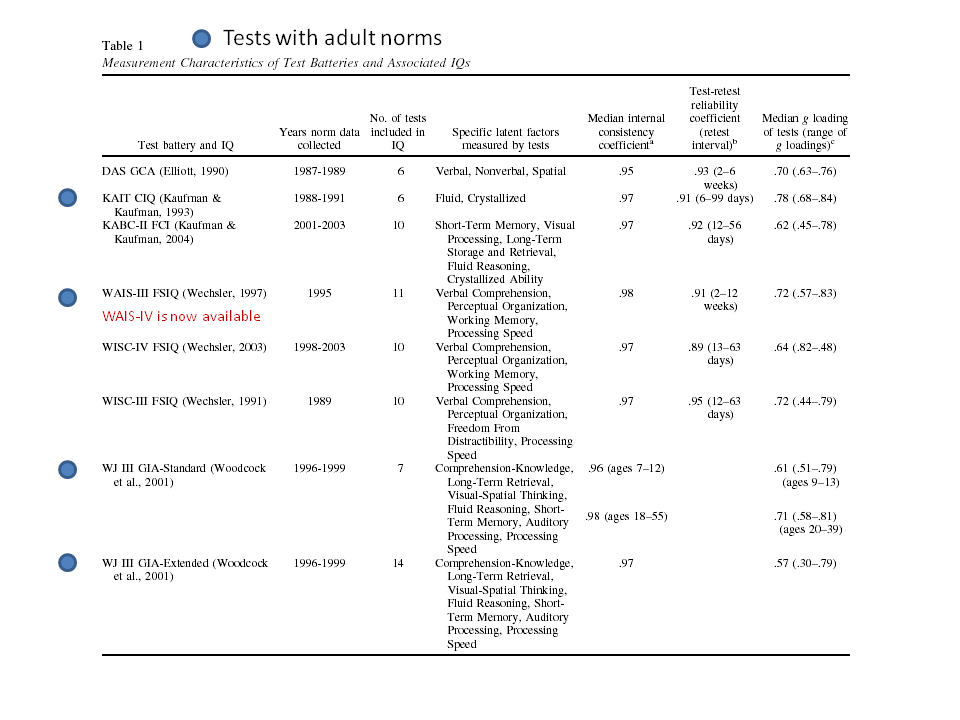
First, as I've mentioned before, in 2002 a national panel of experts made recommendations re: the use of intelligence and adaptive behavior tests in MR/ID eligibility determination (for SSA benefits).  In that publication a table was presented that listed the comprehensive intelligence batteries deemed suitable for MR/ID determination.  The table can be viewed by clicking here.  Only three of the batteries listed at that time had adult norms.  Also, many of the tests have since been revised/renormed--thus making the basic information in the table out-of-date.  The important point is that there are other intelligence tests (beyond the Wechsler "gold standard") that have been deemed appropriate for MR/ID identification/Dx/classifcation by a national panel of experts.

Floyd, Clark and Shadish (2008) reported on the exchangability of full scale IQ scores from most of the major comprehensive intelligence batteries.  In that article they provide an excellent descriptive summary table of the major characteristics of the respective test batteries.  This table is reproduced below...with a few annotations. [Click here for a larger version of the table image - when image appears, click on it to make it bigger].


Finally, the Floyd et al. article makes reference to supplementary material  availbale upon request.  One piece of this supplementary information is a lengthy footnote describing the various full scale IQ scores (which are typically the primary focus in Atkins cases...for good or bad) available from the different IQ batteries.  I've reproduced the footnote (with embedded URL links to the product descripton web page of each respective publisher)--click here to view.

Thats enough for now.  This is just a start in ICDPs attempt to provide comparative information on intelligence test results that may appear in psychological reports reviewed in Atkins cases.

Technorati Tags: , , , , , , , , , , , , , , , , , , ,


Thursday, October 15, 2009

CHC theory and IQ testing in Atkins decisions: Recognition by intelligence scholars


By now regular readers of this blog know I have a significant concerns re: the first prong of mental retardation determination (intelligence) in Atkins cases being determined, over and over, primarily on the basis of scores from the WAIS-R/III/IV.  I repeatedly mention the need for Atkins intelligence experts to base their intelligence testing and testimony on state-of-the-art psychometric theories of intelligence.  In particular, I frequently reference the need for the Cattell-Horn-Carroll (CHC) theory of cognitive abilities to be used as the organizational framework for intellectual test data and the determination of intellectual functioning.  I typically provide links to two sources (one a pre-pub version of a book chapter that was eventually published; the other an invited 2009 editorial in the journal Intelligence). 

If readers take time to read these sources, they will learn that CHC theory is the combination of Cattell-Horn Gf-Gc theory and Carroll's three-stratum Gf-Gc theory [Carroll, J. B. (1993). Human cognitive abilities:  A survey of factor analytic studies. New York: Cambridge University Press].  I cannot stress enough the importance of the development of CHC theory for evidence-based intelligence theories and test development and interpretation.

To add external credibility to my professional opinion, I suggest skeptical readers read the words of major intelligence scholars as they rendered judgment on the Carroll portion of the CHC model.  Below are a few select quotes.  The conclusion should be obvious. Top notch intelligence scholars recognize the seminal work of Carroll, which is a major cornerstone of CHC theory.  I'll let the words of these giants speak for themselves.

Richard Snow (1993; back cover jacket of Carroll's, 1993 book):
 “John Carroll has done a magnificent thing. He has reviewed and reanalyzed the world’s literature on individual differences in cognitive abilities…no one else could have done it… it defines the taxonomy of cognitive differential psychology for many years to come.”

Burns, R. B. (1994). Surveying the cognitive terrain. Educational Researcher, 35-37.
Carroll’s book “is simply the finest work of research and scholarship I have read and is destined to be the classic study and reference work on human abilities for decades to come” (p. 35).

Horn, J. (1998). A basis for research on age differences in cognitive abilities. In J.J. McArdle, & R.W. Woodcock (Eds.), Human Cognitive Abilities in Theory and Practice (pp. 57-92). Mahwah, NJ: Lawrence Erlbaum.
A “tour de force summary and integration” that is the “definitive foundation for current theory” (p. 58).  Horn compared Carroll’s summary to “Mendelyev’s first presentation of a periodic table of elements in chemistry” (p. 58). 
Jensen, A. R. (2004). Obituary - John Bissell Carroll. Intelligence, 32(1), 1-5.
…on my first reading this tome, in 1993, I was reminded of the conductor Hans von Bülow’s exclamation on first reading the full orchestral score of Wagner’s Die Meistersinger, ‘‘It’s impossible, but there it is!’’

“Carroll’s magnum opus thus distills and synthesizes the results of a century of factor analyses of mental tests. It is virtually the grand finale of the era of psychometric description and taxonomy of human cognitive abilities. It is unlikely that his monumental feat will ever be attempted again by anyone, or that it could be much improved on. It will long be the key reference point and a solid foundation for the explanatory era of differential psychology that we now see burgeoning in genetics and the brain sciences” (p. 5).


Technorati Tags: , , , , , , , , , , , , , , , , , , , , , , ,


Tuesday, September 29, 2009

Book recommendation: Mental Retardation--Determining Eligibility for SS Benefits


I recommend the book Mental Retardation:  Determining Eligibility for Social Security Benefits) to professionals engaged in Atkins MR death penalty related assessments and decisions, especially since it is relevant to the Vidal (2007) California Supreme Court decision (prior post) where the court and experts grappled with the use of the Wechsler Verbal IQ (and not Full Scale IQ) in estimating Vidal's general intelligence.  The topic of part vs total scores from IQ tests is discussed in detail, and there was some dissent within the committee that produced the book.

It is not a widely known book given its narrow focus (determining mental retardation for social security benefits).  I recommend it as a starting point for a number of intelligence test issues in Atkins cases as the book is the result of a two year process comissioned by the National Academy Press/National Research Council.  The Committee on Disability Determination for Mental Retardation consisted of 16 experts from various disciplines.  The issues and recommendations for MR assessment and eligibility determination for SS eligibility, which are not much different from the three-prong criteria used when deciding Atkins cases, are based on a national expert panel.  Although determining MR eligibility for social security benefits is a much less serious decision than determining MR for Atkins capital punishment cases, the eligibility issues discussed are nearly identical.

The book covers the topics of policy context, the role of intellectual and adaptive behavior assessment, the relationship between intelligence and adaptive behavior, differential diagnosis, and the panels recommendations.

Again...I mention this book primarily because it is a good starting point for reflecting on the Vidal (2007) court decision that hinged on the use of a Verbal IQ score (and not the Full Scale IQ score) in the  determination of Vidal as qualifying as  MR (part vs total score discussion in the text).

When time permits I will likely summarize the key issues and recommendations from the book as they related to the part vs total IQ score issue.  It is a complicated issue.

Conflict of interest notes
  • As mentioned in the acknowledgements section of  the book, I was one of a number of  individuals who provided feedback on earlier drafts of the manuscript.
  • Also, it is interesting to note, that Dr. Keith Widaman, a leading scholar in intelligence, adaptive behavior, and developmental disabilities research, was a member of the panel and was one of the expert witnesses in the Vidal court decision.  I have the highest professional regard for Dr. Widaman's expertise and credentials.  He is one of the top research methodologists in psychology and a leading scholar in intelligence, adaptive behavior and mental retardation.  I regularly see and chat with Dr. Widaman at the annual ISIR conference.  Furthermore, Dr. Widaman and I coauthored a chapter on adaptive behavior (The Structure of Adaptive Behavior;  Widaman & McGrew, 1996) published in the 1996 Americian Psychological Association (APA) Manual of Diagnosis and Professional Practice in Mental Retardation.  Reflecting his scholarly integrity, Dr. Widaman's reported expert testimony in the Vidal case is 100% consistent with his minority dissenting opinion (in the MR-SS related book) regarding the issue of part vs total IQ scores for diagnosing mental retardation.

Technorati Tags: , , , , , , , , , , , , , , , , , ,


Friday, September 25, 2009

Determining Current Level of Intellectual Functioning: The Courts Dropped the Ball (guest post by K. Foley)


On month ago the US 5th Circuit Court of Appeals rendered a psychometrically puzzling (and troubling) decision in an Atkins mental retardation death penalty case, in favor of the defendant...Eric Lynn Moore.  It was brought to my attention by Kevin Foley who wanted to share his observations regarding the decision (in a guest blog post), particuarly since the ruling hinged on the unusal procedure of mathematically averaging three different IQ scores obtained across decades.  According to the records, the courts averaged a group IQ score administered when the defendent was 7 years old, a 1991WAIS-R, and a 2004 WAIS-III.  Although the scores were very consistent, I have never heard of such a simple mathematical method being applied to scores from different tests across such a long period of time.  The measurement questions raised by this simplistic approach are beyond the scope of a single blog post. 

My initial amazement is echoed in a  32 page dissenting opinion by Appeals Judge Jerry Smith.  As per an AP story
  • Appeals Judge Jerry Smith, in a 32-page dissent that was twice as long as the court's decision, called the majority ruling "intellectually sluggish" and chastised his colleagues on the court for using "haphazardly-applied standards of review, casually-read caselaw, and superficially-scrutinized evidence." 
 Judge Smith's dissenting opinion starts on page 16 of the final court ruling.


Kevin Foley was similarly struck by the manner in which the court invoked the simplistic approach to establishing mental retardation.  As a result, he wrote the following guest blog post which I'm posting on his behalf "as is."  In addition, I've located copies of the final ruling (click here), and three prior appeals (click here, here, and here). 

I've only skimmed the final ruling but would urge all psychologists  involved in Atkins cases, or psychologists who do intellectual testing of any kind, to read it.  The ruling is an interesting window into a courts logic re: how intelligence testing and scores can be viewed...and how  measurement and psychometric principles can be ignored.   Aside from the simple arithmetic averaging of three different IQ scores, other interesting comments center on the WAIS being the "standard" IQ test for Atkins cases and the argument for determining an MR diagnosis based on IQ scores only (dismissal of adaptive behavior evidence and testimony).  I will be reading it more and may offer additional comments upon greater reflection. 

Below is the Kevin Foley's unedited guest post:

Moore v. Quarterman, Case No. 05-70038, 5th Cir., Aug. 21, 2009 (unpublished).

Eric Lynn Moore, an African American inmate under a sentence of death, sought to escape the death penalty by invoking Atkins. The federal district court ruled in Moore’s favor, exempting him from the death penalty. The state appealed. According to the Fifth Circuit Court of Appeals, Moore obtained the following IQ scores: a 76 on the WAIS-R; a 66 on the WAIS-III; and a 74 on the Primary Mental Abilities test. Moore also scored in the bottom eight-tenths of a percentile on the TONI-2. The dissenting opinion in Moore states that the PMA was given to Moore when he was in the first grade; the WAIS-R was given to Moore, in prison, in 1991; and the WAIS-III was given to Moore in 2004. The district court resolved the issue of Moore’s current intellectual functioning by averaging the three scores to come up with an average score of 72, to which he applied the standard error of measurement. The appeals court approved this approach, stating, “In averaging the test scores and relying on the five-point margin of error . . . the district court attempted to find a way to reconcile all three test scores.”

The lone dissenting judge issued a scathing dissent, including biting comments accusing the majority of using “[h]aphazardly-applied standards of review, casually-read case law, and superficially-scrutinized evidence [which] make for an unfortunate combination; here, they result in shallow analysis and the wrong result. The only mitigation is that the majority opinion is unpublished, so it is not binding on anyone or any court.” Ouch!

The dissent correctly, in my opinion, took the trial and appeals courts to task on the issue of using an average of IQ scores from as far back as 1973 to determine current level of functioning. First, the trial court neglected to address issues surrounding the accuracy of the three scores. According to the dissent,

“All three of those test results were called into question at the evidentiary hearing. The PMA score, for example, is only a number; there is no evidence that it was properly scored or whether it was administered individually, as the test protocol requires, or to an entire school class. The vocabulary section of the WAIS-R, according to [defense expert] Llorente, was improperly scored, and in a way that may have slightly inflated the score. Llorente also testified concerning the ‘Flynn Effect,’ the apparent increase in the average IQ scores in populations over time, as measured by a given IQ test. Because the WAIS-R was an older test when it was administered to Moore, Llorente suggested adjusting Moore’s score of 76 downward by about four points.”

In addition, the state’s expert asserted that Moore’s expert improperly scored the WAIS-III test. The dissent correctly complained that the trial court took the easy way out by averaging the scores.

“Instead of grappling with those conflicting upward and downward adjustments, the district court gave the three scores equal weight, averaged them, reached an IQ of 72, applied the ‘five-point standard error of measurement,’ and therefore concluded that Moore had borne his burden of proof. It is that finding, and the district court’s actual reasoning in making it, that the panel must consider, and yet the majority refuses to address it at anything resembling an acceptable level of detail. . . .

“For one thing, there is no legal or record support for taking an average of Moore’s IQ scores. Averaging IQ scores is, to say the least, a creative approach to their analysis and comparison and is highly unusual. Neither expert suggested, employed, or endorsed it. The district court assumed, without any evident backing, that averaging is a meaningful way to compare scores from different IQ testing protocols administered years apart and that the margin of error was the same for all three and was the same after the averaging as before. All of those assumptions are facially implausible, and the district court had no apparent reason to think any of them is correct.”

Although the dissent erred in other respects (some of which may make for other interesting blog entries), it hit the nail on the head on this issue. Although these issues – assertions of invalid results, mis-scoring of tests, application of the Flynn Effect, and determining what weight to give to certain evidence - might be complicated and hard to resolve, that is what courts do. They should educate themselves and use the experts to provide the information necessary to properly decide the case. Moreover, federal judges can appoint an independent expert to offset the parties experts, it the judge feels the need for some impartial testimony to help guide the court.

Technorati Tags: , , , , , , , , , , , , , , , ,


Thursday, September 24, 2009

Applied Psychometrics 101: How IQ tests are developed


This past summer I was asked to conduct an introductory level four hour course on the "art and science of test development" for an international psychological assessment conference in Brazil.  It was the first time in 25 years of clinical testing and applied cognitive/IQ/achievement test development that I had ever tried to put the basics of applied test development down in a presentation.  The end result was a series of modules (which are "works in progress") that can be viewed on-line via my sister blog, IQs Corner. 

You can access them by visiting the last post I made re: these PPT modules or go to the main IQs Corner home page and look for the Applied Test Development Series section on the left blog panel.

The goal of the modules is to educate laypersons, psychologists, and other professionals in  the basics of how intelligence (and achievement) tests are developed...kind of an "IQ test development for dummies" series.  It is hoped these materials will increase the sophistication of knowledge of people who use intelligence tests and/or are consumers of intelligence test results (e.g., physicians, lawyers, judges, etc).  The long-term goal will be to turn the PPT modules into either a series of Applied Psychometric 101 research reports or cobble them together in a grand single manuscript.

Enjoy.  Feedback is always welcomeTechnorati


Tuesday, September 22, 2009

Book Review: IQ Testing 101 by Alan Kaufman


Anyone involved in the field of intelligence testing is familiar with the work of Dr. Alan Kaufman, a leading expert on interpretation of the Wechsler intelligence batteries, an author of his own intelligence tests, and a scholar/researcher who has published extensively in professional psychology journals on various aspects of intelligence and intelligence testing.

This past week I was pleased to receive a copy of his new book:  IQ Testing 101.  The number of books and published articles re: intelligence testing is beyond comprehension by any single reader.  Thus, although only having skimmed select sections at this time, I can say that this is the book I would recommend to anyone who wants an easy-to-read, accurate, introductory overview of the past and current state-of-the-art of the field of intelligence testing.  It appears to be an excellent book for those first learning about intelligence testing and for non-psychologists (e.g., physicians, lawyers, etc.) who want to become familiar with the basics of the field of IQ testing. 

Table of Contents

Chapter 1: Why Would Anyone Want to Read a Book About IQ Testing?
Chapter 2: History, Part 1: Who Invented the IQ Test?
Chapter 3: History, Part 2: At Long LastTheory Meets Practice
Chapter 4: The IQ Construct, Part 1: We All Know What IQs AreDont We?
Chapter 5: The IQ Construct, Part 2: How Accurate Are IQ Tests?
Chapter 6: Hot Topic: Is IQ Genetic?
Chapter 7: Hot Topic: Are Our IQs Fixed or Are They Malleable?
Chapter 8: Hot TopicIQ and Aging: Do We Get Smarter or Dumber as We Reach Old Age?
Chapter 9: Hot TopicIQ Tests in the Public Forum: Lead Level, Learning Disabilities, and IQ
Chapter 10: The Future of IQ Tests

References
Index