Showing posts with label BAT III. Show all posts

Saturday, December 15, 2012

Atkins MR/ID Court Decision: Maldonado v TX (2012)


The Atkins MR/ID case of Maldonado in Texas has been commented on numerous times at this blog. A new hearing was held this past October and the court decision rendered yesterday. Having served as an expert witness in this last hearing, I post the decision without comment.
Maldonado v Texas (2012)


Wednesday, April 21, 2010

IQ Test DNA Fingerprints: Comparison of WJ III/BAT III to WJ-R/BAT-R

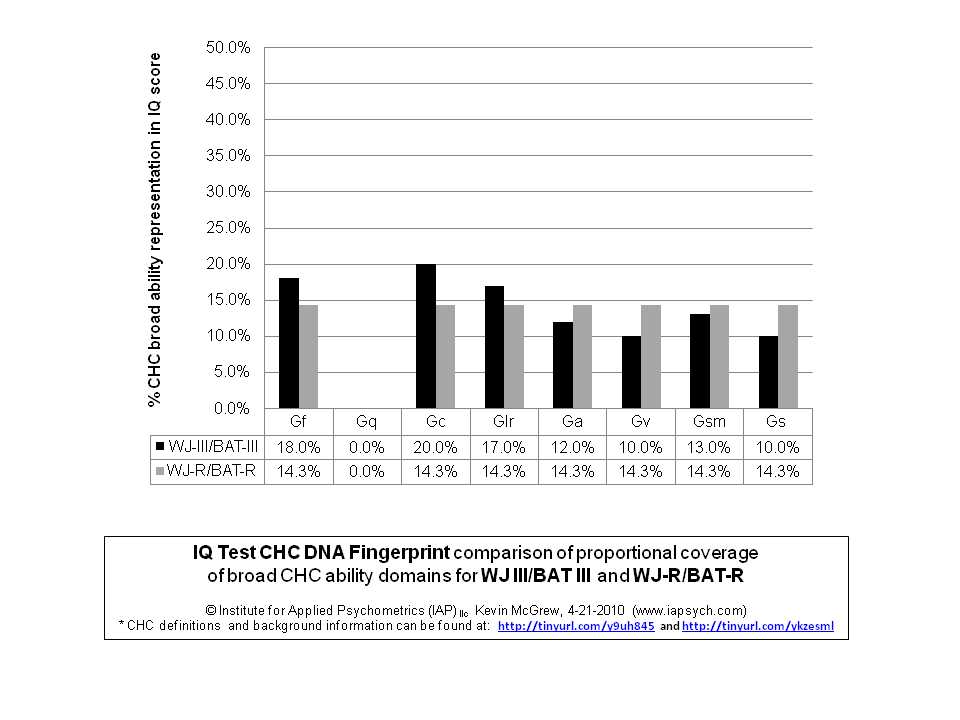
Here is another of IQ's Corner "IQ Test CHC DNA Fingerprint" test comparison series.  This particular CHC fingerprint figure compares the CHC composition of the respective full scale total composite IQ scores from the WJ III/BAT III and the the earlier version of these batteries....the WJ-R/BAT-R.

Background information regarding the development, use and interpretation of this IQ global IQ score feature can be found at a prior post and in the IQ Test CHC DNA Fingerprint section on the blog side bar.

I now present a comparison of the R/III versions of the WJ/BAT batteries as I have seen psych reports where a subject had previously been administered the WJ-R and was later tested with the revised WJ III (in the case of Spanish-speaking individuals, I've seen the BAT-R and the BAT-III---click here for more background information on the Spanish version of the WJ III...the BAT III).  

In the case of the WJ-R/BAT-R, the full scale IQ composite is called the Broad Cognitive Ability (BCA) cluster.  The name was changed in the WJ III/BAT III to General Intellectual Ability (GIA) cluster.  The name change was not cosmetic.  The use of the term "general intellectual ability" in the newest WJ III/BAT III reflects the fact that this global IQ composite score is designed to be the best statistical estimate of the theoretical construct of general intelligence (g) via the use of differential test weights.

Using principal components analysis, a g-factor was extracted from the seven WJ III/BAT III Standard Cognitive battery tests (at each age level), g-factor weights calculated (by age---they shift slightly as a function of age), and the g-weights used to differentially weight the contribution of the seven tests to the composite GIA-Standard cluster score.  The same process was completed for the 14 test GIA-Extended cluster score.  This procedure is explained in detail in the WJ III/BAT III technical manuals/reports and is also briefly summarized in a free on-line Assessment Service Bulletin technical abstract.

In the case of the WJ-R/BAT-R, the respective 7-test BCA-Standard and 14-test BCA-Extended cluster scores are based on the simple arithmetic average of each set of scores, thus resulting in an equally weighted global IQ score.

Thus, differences between the global WJ-R/BAT-R and WJ III/BAT III IQ scores may occur as a function of the respective scores reflecting differential contributions of the broad Gf-Gc abilities as per the CHC theoretical model that underlies the batteries.

Below is the IQ Test CHC DNA Fingerprint comparison of the two respective editions of the WJ-R/BAT-R and WJ III/BAT III.  The weights presented for the WJ III/BAT III are the median (average) weights across all age groups.  The previously referenced ASB (see above) includes a table of the specific weights by age.

[double click on figure to enlarge]

Although the CHC composition of the respective global IQ scores did not change dramatically, there are enough differences by CHC ability to suggest that slightly different global IQ scores may be produced for the same individual depending on whether they took the WJ-R/BAT-R or the WJ III/BAT III (assuming proper administration, scoring, etc.).  Consistent with psychometric intelligence theory (aka., CHC theory), the WJ III/BAT III global IQ scores (GIA-Stnd; GIA-Ext) are more heavily weighted as per a subjects performance on the more g-loaded measures of Gf (fluid intelligence/reasoning), Gc (crystallized intelligence or comprehension-knowledge), and Glr (long-term storage and retrieval).  In contrast, abilities that are less cognitively demanding and more related to perceptual (Gv, Ga), speed (Gs), and short-term memory (Gsm) functioning contribute slightly less to an individuals WJ III/BAT III global IQ GIA score than was the case with the WJ-R/BAT-R.

If significant differences are found when comparing scores from the respective R/III editions of the WJ for an individual, examiners should review the Gf-Gc CHC test/cluster profiles to determine if some (or all) of the score differences might be related to the shift from an equally weighted global IQ score (WJ-R/BAT-R) to a differentially-weighted (WJ III/BAT III) global IQ score.  In theory, an individual could obtain very similar test-level scores on each battery, but because "all scores are not created equal" (in the estimation of general intelligence or g) in the case of the WJ III, a shift in the global GIA IQ scores may occur.

Other IQ Test CHC DNA Fingerprint comparisons can be found by clicking here.  More will be coming in the future.

[Conflict of interest note:  I am a co-author of the WJ III/BAT III]

Technorati Tags: , , , , , , , , , , , , , , , , , , , , , , , , , , , , , , , , , ,

Friday, April 9, 2010

Spanish Woodcock-Johnson Battery III: Bateria III (BAT III) use in ID/MR assessmnet

As a coauthor of the WJ III/BAT III, I've been receiving increasing emails and phone calls for information describing the BAT III and its appropriateness for assessing intelligence in Atkins ID/MR cases.  I do have an obvious conflict of interest as a co-author, but I believe it is is one of the most psychometrically and theoretically sound measures of human intelligence for Spanish-speaking individuals where a Dx of ID/MR is in question.

To save everyone (including me) many e-mails and phone calls, I've decided to post everything I have (in e-form) regarding the BAT III.  In addition, I'm posting information re: the prior edition (BAT-R) as the procedures used to adapt, translate and norm (via US-equated norm procedures) are the same. 

Below are key documents.
I hope people find this information useful.  I will also soon post a comparison of the CHC content of the two batteries (CHC DNA Fingerprint Analysis comparison of BAT-R and BAT III).

Finally, although I have not updated it for over a year, given that the BAT-III is parallel to the WJ III, individuals may want to review available published and unpublished research on the WJ III (and to a lessor extent the BAT III).  This can be found at the WJ III EWOK (v3.0; Evolving Web of Knowledge) at IQs Corner blog.

Technorati Tags: , , , , , , , , , , , , , , , , , , , , , , , , , , , , , , , , ,

Monday, September 7, 2009

Use of the Mexican WAIS-III in MR capital Atkin cases: Controversy reported in Applied Neuropsychology journal


Is the Mexican normed version of the WAIS-III appropriate for use in diagnosing mental retardation and, more importantly, is it appropriate for use in Atkins MR death penalty cases? Apparently a controversy has surfaced re: this question as reflected by three articles in the journal Applied Neuropsychology.

As background note, I've blogged previously about a special issue of this journal that dealt with Atkins cases. I've not completed reading all of those articles yet...there simply is not enough time in my day.

Given my obvious conflict of interest [I'm a coauthor of the competing WJ III and BAT III], I will not render any judgment "pro" or "con" regarding the debate. Instead, I'm making available (below) the abstract of a series of three articles published in the latest issue of Applied Neuropsychology that address the issue. Suen and Greenspan (2009a) make the case against the use of the Mexican WAIS-III. Escobedo and Hollingworth (2009) respond to Suen and Greenspan (2009a). Suen and Greenspan (2009b) then respond to Escobedo and Hollingworth (2009).

Readers will need to review the articles and make their own informed judgments. I would like to invite appropriatelly qualified scholars to consider submitting a guest comment post on all three articles and any other journal published research that bears on this specific controversy. If interested, contact me at my email in my "About Me" section of this blog. In addition, given my conflict of interest, I am requesting that anyone familiar with any similar controversies or questions regarding the BAT III to bring them to my attention as I would make those published articles available for review...also without comment.

Suen, H. K. & Greenspan, S. (2009a). Serious Problems with the Mexican Norms for the WAIS-III when Assessing Mental Retardation in Capital Cases. Applied Neuropsychology, 16 (3), 214-222. (click here).
A Spanish-language translation of the Wechsler Adult Intelligence Scale-III (WAIS-III), normed in Mexico, is sometimes used when evaluating Spanish-speaking defendants in capital cases in order to diagnose possible mental retardation (MR). Although the manual for the Mexican test suggests use of the U.S. norms when diagnosing MR, the Mexican norms—which produce full-scale scores on average 12 points higher— are sometimes used for reasons that are similar to those used by proponents for ‘‘race-norming’’ in special education. Such an argument assumes, however, that the Mexican WAIS-III norms are valid. In this paper, we examined the validity of the Mexican WAIS-III norms and found six very serious problems with those norms: (1) extremely poor reliability, (2) lack of a meaningful reference population, (3) lack of score normalization, (4) exclusion of certain groups from the standardization sample,(5) use of incorrect statistics and calculations, and (6) incorrect application of the true score confidence interval method. An additional problem is the apparent absence of any social policy consensus within Mexico as to the definition and boundary parameters of MR. Taken together, these concerns lead one to the inescapable conclusion that the Mexican WAIS-III norms are not interpretable and should not be used for any high-stakes purpose, especially one as serious as whether a defendant should qualify for exemption against imposition of the death penalty.

Escobedo, P. S. & Hollingworth, L. (2009) Annotations on the Use of the Mexican Norms for the WAIS-III. Applied Neuropsychology, 16 (3), 223-227 (click here).
This article provides crucial information to judge the appropriateness of the Mexican version of the Wechsler Adult Intelligence Scale-Third Edition and recognizes some limitations in both the process of its adaptation to the Mexican population and the norm development process. This is an effort to contribute to the debate initiated by Suen and Greenspan (2008), who argued in court against the use of Mexican norms in a death penalty case, which depended upon establishing the diagnosis of mental retardation. As a part of the defense team, these scholars argued a number of points against the use of the Mexican norms. With input from the lead researcher on the Mexican standardization process, some of the criticisms are addressed, and further information about the norm development process for this test in Mexico is provided in an attempt to be critical about the strengths and weaknesses of the use of existing Mexican norms. Finally, we argue that results from a single test must not be used to make life and death decisions and that test development is a continuous process influenced by culture,language, and indeed by norm-developing procedures and debates.

Suen, H. K. & Greenspan, S. (2009). Reply to Sanchez-Escobedo and Hollingworth: Why the Mexican Norms for the WAIS-III Continue to be Inadequate. Applied Neuropsychology, 16 (3), 228-229 (click here).
The discussion in Drs. Sanchez-Escobedo and Hollingworth’s paper independently confirms virtually all our observations regarding the psychometric and interpretive deficiencies of the Mexican norms for very high-stakes decisions, such as that involved in an Atkins hearing. Test publishers have an ethical obligation to caution potential users against the premature use of a developing assessment that does not yet meet the needed precision and evidence of validity required for very high-stakes decisions.

Technorati Tags: , , , , , , , , , , , , , , , , , , ,