Sent from Kevin McGrew's iPad
An attempt to provide understandable and up-to-date information regarding intelligence testing, intelligence theories, personal competence, adaptive behavior and intellectual disability (mental retardation) as they relate to death penalty (capital punishment) issues. A particular focus will be on psychological measurement, statistical and psychometric issues.
Saturday, May 14, 2011
FYiPOST: Weaving Functional Brain Imaging into the Tapestry of Evidence: A Case for Functional Neuroimaging in Federal Criminal Courts by Adam Teitcher :: SSRN
Sent from Kevin McGrew's iPad
Friday, May 13, 2011
FYiPOST: Alesini and La Ferrara on Testing Racial Bias in Capital Sentencing
Sent from Kevin McGrew's iPad
Wednesday, May 11, 2011
Research brief: Simplifying Miranda right warnings so they are understood by people with cognitive or language limitations
- iPost using BlogPress from my Kevin McGrew's iPad
intelligence intelligence testing Atkins cases ICDP blog psychology school psychology neuropsychology forensic psychology criminal psychology criminal justice death penalty capital punishment ABA IQ tests IQ scores adaptive behavior AAIDD mental retardation intellectual disability Miranda Miranda warning Miranda rights
Generated by: Tag Generator
Tuesday, May 10, 2011
FYiPOST: Top-Ten Recent SSRN Downloads
Sent from Kevin McGrew's iPad
Interesting stuff on graphical abstracts of research articles
http://www.elsevier.com/wps/find/authorsview.authors/graphicalabstracts
Sent from Kevin McGrew's iPad
Kevin McGrew, PhD
Educational Psychologist
Saturday, May 7, 2011
Why Academics should blog@BrainCosmos, 5/7/11 2:38 AM
5/7/11 2:38 AM Why Academics Should Blog: A College of One's Own bit.ly/m3PUnn |
Sent from Kevin McGrew's iPad
Friday, May 6, 2011
Atkins MR/ID Court Decision: Turner v US (FL; 2011)
Thanks again to Kevin Foley for sending me this interesting case with a brief summary overview.
The Eleventh Circuit Court of Appeals recently decided the William Turner case. The case was an application for permission to file a subsequent federal habeas corpus claim. The 11th Circuit denied the application, and in doing so, upheld the Florida Courts' denial of Turner's Atkins claim.
After Atkins was decided, Turner sought to prove he was ID. Apparently, he initially presented the courts with evidence that he obtained childhood IQ scores of 72 and 73. Eventually, the Florida trial court appointed two experts to assess Turner. Turner obtained a FSIQ of 98 on the WAIS-III and a FSIQ of 108 on the SB-5. The trial court summarily denied the claim, without an evidenciary hearing, on the basis that there was no way Turner could show he was ID. The FL Supreme Court affirmed.
Of some significance was the fact that Turner served a combat tour in Vietnam and was honorably discharged from the military. He also graduated from high school - according to the 11th Circuit:
"Turner graduated from high school in the third quartile of his class and attended junior college [which] also refutes Turner’s contention."
His lawyers were nonplussed. Similar to the another recent case commented on via a guest blog post by Kevin Foley, the attorneys appeared to believe that all they had to show was that Turner was ID before age 18. As for the problem with the 26 or 36 point gain in IQ (depending on whether you look at the WAIS-III or the SB-5) from childhood to adult, the attorneys argued in their brief to the Florida Supreme Court that,
"for the past 24 years on death row he has strenuously worked to improve his intellectual functioning and academic skills. Now 64 years old, and a survivor of prostate cancer and radical surgery, Turner has spent the last quarter century doing virtually nothing but watching educational public television every day and diligently practicing his reading, communication, social sciences, and math skills. . . This hard work over the past 24 years is reflected in substantial increases in Turner’s IQ scores since childhood."
Interesting argument, but such a large increase in IQ scores make an ID/MR claim dubious and raises interesting issues about the third prong of the Dx (MR/ID during the developmental period)
- iPost using BlogPress from my Kevin McGrew's iPad
intelligence intelligence testing Atkins cases ICDP blog psychology school psychology neuropsychology forensic psychology criminal psychology criminal justice death penalty capital punishment ABA IQ tests IQ scores adaptive behavior AAIDD mental retardation intellectual disability third MR/ID prong Turner v US Turner v FL
Generated by: Tag Generator
Thursday, May 5, 2011
Wednesday, May 4, 2011
FYiPOST: Neuroscience and Law Webinars from the ABA and AAAS
Sent from Kevin McGrew's iPad
Saturday, April 30, 2011
Research brief: Trail Making Test (Connections)--Measures Gf and Gs CHC abilities (Salthouse, in press)
- iPost using BlogPress from my Kevin McGrew's iPad
intelligence IQ tests IQ testing IQ scores CHC intelligence theory CHC theory Cattell-Horn-Carroll human cognitive abilities psychology school psychology individual differences cognitive psychology neuropsychology psychology special education educational psychology psychometrics psychological assessment psychological measurement IQs Corner general intelligence working memory Trail Making Test Gf Gs fluid intelligence processing speed
Generated by: Tag Generator
Court Fails To Bite on Defense Chicanery (Guest post): Atkins MR/ID decsions--Meyers v AL (2011)
A recent Atkins MR/ID decision re: Myers v Allen (AL; 2011, 2009, 2007) has been posted to the ICDP Court Decision blogroll. In addition, regular ICDP contributor, Kevin Foley, has provided the following guest blog commentary.
Court Fails To Bite on Defense Chicanery - Guest post by Kevin Foley.
Alabama inmate Robin Myers’ federal habeas attorneys claimed that Myers was mentally retarded (intellectually disabled). Myers had a big problem – his most current IQ testing on the WAIS-III, administered in 2006 - a year or so before his hearing when he was about 45 years old - showed a valid full scale IQ score of 84. Under most current definitions of intellectual disability, such a score sounds the death knell for an Atkins claim, since a person must prove that he currently intellectually disabled, and that he has scores which satisfy the first prong of the diagnosis. If the Flynn Effect was applied to his score, the most Myers could gain would be about 3 points, meaning his level of intellectual functioning would still be an 81, outside the range for a diagnosis of intellectual disability.
Since Myers had some full scale IQ scores when he was a child that were in the intellectual disability range (75, 74, 71, and 64), his attorneys argued that what was relevant to the claim was whether Myers was intellectually disabled before age 18. The defense expert, “testified . . . that he was asked only to form and express an opinion about petitioner’s mental capacity before the age of 18, not his current capacity or his capacity at the time of the murder.” The court rejected the ploy, concluding that, “it is clear that Alabama courts would find that evidence of an IQ below 70 as a child, absent additional evidence of similar current scores and current deficits in adaptive skills, is not sufficient to render a defendant exempt from the death penalty. The Alabama Supreme Court specifically noted that ‘focus on [the defendant’s] functioning before the age of 18 is misplaced’ when that defendant’s ‘intellectual functioning and behavior as an adult places him above the mentally [retarded] range.’”
The court was also unimpressed with the defense expert’s attempt to explain the 20 point increase in IQ score from childhood to adult (the expert contended that the childhood IQ score of 64 to be “the most accurate and complete’). According to the magistrate judge’s opinion, the defense expert “further explained the improvement in Mr. Myers’ IQ scores as a result of brain injury”. Of course, one typically associates a brain injury with a potential decline in intellectual functioning, not a gain. But the expert’s proffered explanation was of no consequence to the court, which pointed out that notwithstanding this explanation, the expert, “does not consider [Myers] to be mentally retarded at the present time.”
- iPost using BlogPress from my Kevin McGrew's iPad
intelligence intelligence testing Atkins cases ICDP blog psychology school psychology neuropsychology forensic psychology criminal psychology criminal justice death penalty capital punishment ABA IQ tests IQ scores adaptive behavior AAIDD mental retardation intellectual disability Meyers v Allen Meyers v Alabama
Generated by: Tag Generator
Sunday, April 24, 2011
FYiPOST: Top-Ten Recent SSRN Downloads
Sent from Kevin McGrew's iPad
Saturday, April 23, 2011
Atkins MR/ID Court Decision: O'Neal v Ohio (2010, 2011)
Recent Atkins decisions regarding O'Neal v Ohio. Federal magistrate's opinion from October and the recent opinion of the district judge.
- iPost using BlogPress from my Kevin McGrew's iPad
intelligence intelligence testing Atkins cases ICDP blog psychology school psychology neuropsychology forensic psychology criminal psychology criminal justice death penalty capital punishment ABA IQ tests IQ scores adaptive behavior AAIDD mental retardation intellectual disability O\Neal v Ohio
Generated by: Tag Generator
Wednesday, April 20, 2011
Differential Ability Scales (DAS-II): General factor loadings and specificity - article "in press"
- iPost using BlogPress from my Kevin McGrew's iPad
intelligence IQ tests IQ testing IQ scores CHC intelligence theory CHC theory Cattell-Horn-Carroll human cognitive abilities psychology school psychology individual differences cognitive psychology neuropsychology psychology special education educational psychology psychometrics psychological assessment psychological measurement IQs Corner general intelligence working memory DAS-II Differential Abilities Scales
Generated by: Tag Generator
Sunday, April 17, 2011
FYiPOST: Important new book urges "more prudent use of habeas in state criminal cases"
This is an FYIPOST to a post at Sentencing Law and Policy blog.
<snip>. go to link below for the comp,eye post.
Sent from Kevin McGrew's iPad
FYiPOST: Top-Ten Recent SSRN Downloads
Sent from Kevin McGrew's iPad
Friday, April 15, 2011
Death penalty poll@procon_org, 4/15/11 4:25 PM
4/15/11 4:25 PM Pros/Cons: Should the death penalty be allowed? deathpenalty.procon.org/view.answers.php |
Sent from Kevin McGrew's iPad
Eligible for execution: Assessment of intellectual disability as per "Atkins": APA workshop
I can say, without reservation, that these are two some of a best professionals doing work in this area. As you note, they are listed as possible expert consultants here at the ICDP blog.
Double click on image to enlarge.
- iPost using BlogPress from my Kevin McGrew's iPad
intelligence intelligence testing Atkins cases ICDP blog psychology school psychology neuropsychology Forensic psychology criminal psychology criminal justice death penalty capital punishment ABA IQ tests IQ scores adaptive behavior AAIDD mental retardation intellectual disability APA APA workshops
Generated by: Tag Generator
Thursday, April 14, 2011
Psychologist who cleared inmates for death row reprimanded by Texas board
The Texas Tribune: Psychologist Who Cleared Inmates for Death Row Is Reprimanded by Board
A psychologist who examined 14 inmates who are now on Texas’ Death Row — and two others who were subsequently executed — and found them intellectually competent enough to face the death penalty, agreed on Thursday never to perform such evaluations again. Lawyers for the 14 inmates hope the agreement will help their clients, who they argue are mentally handicapped, to escape lethal injection.
As part of a settlement, the Texas State Board of Examiners of Psychologists issued a reprimand against Dr. George Denkowski, whose testing methods have been sharply criticized by other psychologists and defense lawyers as unscientific. Dr. Denkowski agreed not to conduct intellectual disability evaluations in future criminal cases and to pay a fine of $5,500. In return, the board dismissed the complaints against him.
Texas defense lawyers and forensic psychologists across the nation have watched the case closely. Although Dr. Denkowski admitted no wrongdoing and defends his practice, those critical of his methods said the settlement could give those inmates still on death row an important appellate opportunity.
“It really suggests that he screwed up,” said Dick Burr, a lawyer who represents Steven Butler, a death row inmate, and who filed one of the complaints against Dr. Denkowski.
The United States Supreme Court ruled in 2002 that states cannot execute mentally handicapped people. But the court did not provide guidelines for determining whether a person is mentally handicapped, leaving it up to the states to create criteria. Texas courts have generally adopted a three-part definition that requires the convicted inmate to have below-average intellectual function, to lack adaptive behavior skills and to have had these problems since a young age.
Dr. Denkowski was an expert witness whom prosecutors — particularly in Harris County — relied upon to determine whether a murder defendant would be eligible for execution. In 2009, other psychologists and defense lawyers complained to the board of psychologist examiners that Dr. Denkowski used unscientific methods that artificially inflated intelligence scores to make defendants eligible for the death penalty.
Dr. Denkowski published a 2008 article in the American Journal of Forensic Psychology describing his technique for scoring defendants. He said traditional tests did not compensate for social and cultural factors. For example, he wrote, those who come from impoverished backgrounds may not have learned basic skills like using a thermometer or maintaining hygiene simply because those skills were not valued in their community. But that does not necessarily indicate a lack of intellectual function, he said.
Dr. Denkowski also explained why he deviated from the standard use of a test that evaluates adaptive behavior or life skills. The test is typically administered to family members and friends who know the person to ask about how the person functions — whether he is able to pay rent, fill out job applications, read menus, etc.
Dr. Denkowski administered that test to the inmate instead. People close to the individual, he wrote, “tend to understate a defendant’s actual functioning markedly” because they do not want him to face execution.
Other psychologists have rejected Dr. Denkowski’s methods, arguing that they have no scientific basis. The American Association on Intellectual and Developmental Disabilities in its 2010 manual for classifying intellectual disability strongly cautioned against using Dr. Denkowski’s methods “until firmly supported by empirical evidence.”
“What Denkowski has been doing is a pretty radical departure,” said Marc J. Tassé, director of the Ohio State University Nisonger Center and an expert in developmental disabilities. “There’s absolutely no scientific basis to his procedure.”
There is no evidence, Dr. Tassé said, that a person from a poor family is less likely to learn basic life skills. He said he knew of no other forensic psychologist who uses similar methods.
Jennifer Andrews, Dr. Denkowski’s lawyer, said her client vigorously denied that he violated any psychology board rules. Part of the problem, Ms. Andrews said, is that the board has not promulgated specific rules for conducting forensic evaluations for cases involving mentally handicapped individuals.
“Psychologists are left to use their best clinical judgment, which Dr. Denkowski used,” she said.
In 2007, Mark Ellis, a state district judge, concluded in the case of the death row inmate Daniel Plata that Dr. Denkowski’s methods did not align with accepted psychological practices and ethical guidelines. Judge Ellis threw out the 2005 evaluation by Dr. Denkowski, saying it “must be disregarded due to fatal errors in … administration and scoring.”
Mr. Plata’s sentence was commuted to life in 2008, and he is now at the Hodge Unit with other similarly disabled prisoners.
In a 2006 evaluation of Steven Butler, who was convicted in the killing of a store clerk, Dr. Denkowski rejected other I.Q. test scores that indicated Mr. Butler was well below average intelligence. He discounted behavioral evaluations from Mr. Butler’s family and friends, who said the young man could not understand the rules of basketball, had to have others read menus for him and had failed basic classes.
The United States Court of Appeals for the Fifth Circuit has stayed Mr. Butler’s execution pending the outcome of the complaint against Dr. Denkowski.
A clause in the settlement asserts that the agreement cannot be cited in capital punishment appeals, but Mr. Burr said he plans to use it — and Dr. Denkowski’s agreement not to conduct forensic evaluations again — to argue that Mr. Butler should be re-evaluated to ensure that Texas does not execute a mentally handicapped man.
State Senator Rodney Ellis, Democrat of Houston, chairman of the Innocence Project board and a member of the Criminal Justice Committee, said every case involving Dr. Denkowski should be reviewed by the courts.
“We cannot simply shrug our shoulders and sit by and watch while the state uses legal technicalities to execute these intellectually disabled men,” Mr. Ellis said, “especially on the word of someone who is no longer permitted to make these kinds of determinations.”
- iPost using BlogPress from my Kevin McGrew's iPad
intelligence intelligence testing Atkins cases ICDP blog psychology school psychology neuropsychology Forensic psychology criminal psychology criminal justice death penalty capital punishment ABA IQ tests IQ scores adaptive behavior AAIDD mental retardation intellectual disability Dr. Denkowski voodoo psychometrics
Generated by: Tag Generator
FYiPOST:Videos of Stanford Law School's Law and Memory Conference
Sent from KMcGrew iPhone (IQMobile). (If message includes an image-double click on it to make larger-if hard to see)
Tuesday, April 12, 2011
More on Coleman v TN: Tennessee Supreme Court endorses expert testimony concerning IQ of condemned
Just posted the Coleman v TN decision last night. Today SENTENCING, LAW AND POLICY had the following commentary.
-------------------
As explained in this local article, on Monday the "Tennessee Supreme Court ruled ... that lower courts may look at more than IQ numbers in determining whether a death row inmate is intellectually disabled and thus ineligible for execution." Here is more on the ruling:
In ruling on the case of a Memphis man on death row for more than 30 years, the high court said judges also may consider expert witness opinions to determine whether a test score accurately reflects a person's functional IQ.
"We find that (state law) does not require that raw scores on I.Q. tests be accepted at their face value and that the courts may consider competent expert testimony showing that a test score does not accurately reflect a person's functional I.Q. or that the raw I.Q. test score is artificially inflated or deflated," Justice William Koch Jr. wrote in the court's unanimous opinion....
Under Tennessee law, mental retardation, now termed intellectual disability, means significantly below-average intellectual functioning with a functional intelligence quotient of 70 or below; deficits in adaptive behavior, and the intellectual disability must have been manifested by age 18.
The Supreme Court, however, said the law does not indicate what types of evidence may be considered and said there is no requirement that IQ scores be accepted at their face value. The court said the lower courts should have considered testimony from two defense psychologists who said Coleman is intellectually disabled.
The full 46-page ruling in Coleman v. Tennessee, No. W2007-02767-SC-R11-PD (Tenn. April 11, 2011), is available at this link.
Sent from Kevin McGrew's iPad
Monday, April 11, 2011
Atkins ID/MR Death Penalty Court Decision: Coleman v TN(2011)
Another new Atkins decision being added to the ICDP decision blogroll. Coleman v TN (2011).
- iPost using BlogPress from my Kevin McGrew's iPad
intelligence intelligence testing Atkins cases ICDP blog psychology school psychology neuropsychology Forensic psychology criminal psychology criminal justice death penalty capital punishment ABA IQ tests IQ scores adaptive behavior AAIDD mental retardation intellectual disability SEM standard error of measurement Coleman v TN (2011)
Generated by: Tag Generator
Friday, April 8, 2011
FYiPOST: Brain Injury and competency for trail: Law and Biosciences Digest
Sent from Kevin McGrew's iPad
Top 5@SSRN, 4/8/11 1:16 PM
4/8/11 1:16 PM Top 5 SSRN Papers this week: bit.ly/hmT06c |
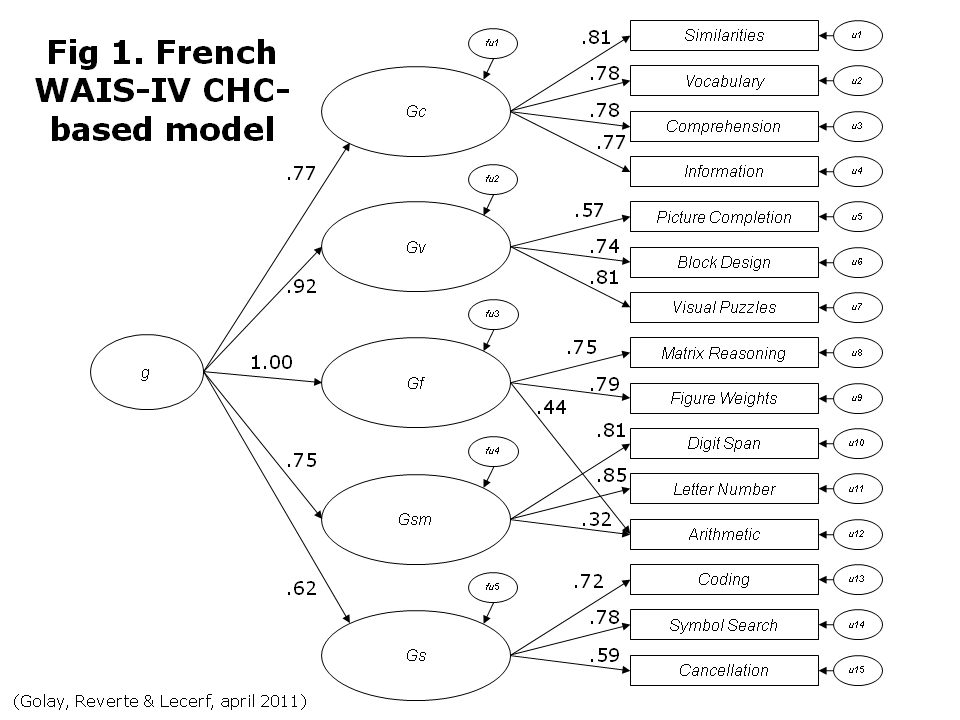
AP101 Brief #8 (guest brief): Independent CFA of the French WAIS-IV by Golay et al. (2011)
This IAP AP101 Brief Report was sent to me for posting by Philippe Golay. It is reproduced "as is" with only minor editing. This is a guest blog/brief report. Figures included should be possible to enlarge by double clicking on them.
If other folks have completed research related to this blog, and would like to make brief post reports, please contact the blogmaster @ iap@earthlink.net
University of Geneva, Switzerland
The fourth edition of the French Wechsler Intelligence Scale for Adult (WAIS-IV) was recently released (Editions du Centre de Psychologie Appliquée – ECPA, 2011). The French WAIS-IV was standardized on a representative sample of 876 people in France ranging in age from 16 to 79. However, for some subtests (Letter Number, Figure Weights and Cancellation), normative data were restricted to 730 participants (and from 16 to 69 years only). In the French WAIS-IV manual, confirmatory Factor analyses were reported, and models with 1, 2, 3 and 4 factors were presented. CFAs supported a factorial structure with 4 factors. Surprisingly, no models based on the Cattell-Horn-Carroll (CHC) theory were reported in the technical manual of the French WAIS-IV. Thus, the main goal of this VERY brief report is to provide a preliminary independent examination of the factor structure of the French WAIS-IV according to the CHC theory. Analyses were conducted on the basis of the subtest inter-correlation matrix and the standard deviations reported in the French manual (p. 50). We used the Akaike Information Criterion (AIC) to compare models.
In the first step, models based on the four-factors solution were tested: four-correlated factors (VCI, PRI, WMI, PSI) and a hierarchical model with four factors and one general factor. We also tested modified versions of the basic 4 factor models because they were suggested and reported in the technical manual. This variant included correlated error terms for Digit Span and Letter Number Sequencing, a cross-loading for Figure Weight on the WMI factor and a cross-loading for Arithmetic on the VCI factor. The model fit of both four factor models (with or without g) was greatly increased as a result. We also tested a bifactor model, in which all subtests scores directly load onto a general factor and also onto one first-order group factor. Results indicated that the bifactor “WAIS-IV” model fits better the data than the other WAIS-IV models.
In a second step, we tested a couple of CHC-based models. We retained a model (fig.1) in which Arithmetic loads both on Gsm and Gf but does not include a cross-loading for Figure Weight on the Gsm factor. This model was better than the basic four-factors WAIS model but slightly less adequate than both modified four-factors solutions. Finally, we tested a bifactor CHC-based model (fig.2). This model with 5 uncorrelated group factors and a first order g factor showed the best fit to the data. The results are summarized in figure 3.
These preliminary results indicated that CHC-based interpretation of the French WAIS-IV is also a valid alternative. Furthermore, bifactor models showed better fit to the data than their higher-order counterparts. This challenges a rather implicit but nevertheless strong assumption that the relationship between the general factor and each subtest is only mediated by the broad abilities.
Tuesday, April 5, 2011
But he doesnt look mentally retarded (intellectually disabled): Guest post by Kevin Foley
But He Doesn’t Look Mentally Retarded (Intellectually Disabled)! Kevin F. Foley
Two federal courts have approved trial court findings that persons – both of whom alleged they were mentally retarded (ID) – simply did not look and act as if they were mentally retarded. In the Atkins matter concerning James Lee Henderson, where the state court concluded that Henderson was not mentally retarded, “The trial judge also explicitly relied upon his personal knowledge and recollection of Henderson’s in-court demeanor during both the trial and [the state court] habeas hearing.” [1]
In an appeal from a denial of a disability claim, the federal appeals court stated, “The ALJ did not err in discrediting Hine’s IQ scores as there is substantial evidence in the record to support this decision. . . . Second, the ALJ found Hines’s demeanor at the hearing inconsistent with a finding of retardation.” [2]
While the word demeanor may sound formal and legalistic, make no bones about it – the word refers to the way a person looked and acted. Demeanor has been defined as the “outward behavior or bearing” of a person. [3]
One has to question the wisdom of such conclusions. As a more insightful federal district judge observed, “The mildly mentally retarded ‘usually live independently or semi-independently in the community and . . . . [o]ften the mildly mentally retarded persons ‘pass’ in the community. In other words, neither their appearance nor demeanor, particularly on brief interaction, reveals the severity of their intellectual deficiency.’” [4] In other words, the conclusion, “But he doesn’t look retarded,” is a dubious one at best.
More recently a district court judge disapproved of a lower tribunal’s use of the “eyeball” technique of diagnosis in a federal disability case. “[I]t appears that the ALJ relied on his personal observations, in part, to discredit the plaintiff’s claim of significantly subaverage general intellectual functioning with deficits in adaptive functioning . . . But here, the court is not convinced that the ALJ’s personal observations, without support from other evidence or professional opinions, can constitute substantial evidence to support the rejection of the plaintiff’s I.Q. score.” [5]
While a person with Down Syndrome may be readily identifiable by the way he or she looks, the majority of the mildly mentally retarded do not suffer from this or a similar genetic disorder. With regard to the way a mentally retarded person looks, “The physical examination may provide evidence of an obvious etiology often associated with mental retardation, such as Down syndrome. More often, however, it will provide only supportive evidence . . . or it will not provide any useful information about etiology at all.” [6] In other words, many mentally retarded persons do not any look any different than their non-intellectually disabled peers.
A primary problem with lay conclusions that someone doesn’t sound or look mentally retarded is there is no reliable way to distinguish those who just barely qualify as “mentally retarded” from those who just barely miss qualifying – simply by the way they act in the formal setting of a courtroom – or elsewhere. As Professor Karen Salekin and colleagues noted, “in comparison with their more severely disabled counterparts, individuals with mild ID are less likely to be identified as having a disability because their outward presentation is not recognizably different from the nonimpaired population.” [7] Moreover, conclusions about a person not appearing to act as if he was mentally retarded can be misleading due to the fact that, “People with mental retardation often respond to such treatment [stigmatization] by trying to ‘pass’ as a person of average intelligence.” [8]
So there we have it – just like with many other aspects of adjudicating intellectual disability, courts can be found coming to the opposite conclusion on the same issue, without apparently being aware of their colleagues’ opposite approach. The need for better guidance and uniformity is obvious, but apparently nowhere on the horizon.
1 Henderson v. Quarterman, U.S.D.C., E.D. Tex., Civil Action No. 1:06-CV-507 (filed Mar. 31, 2008), slip op. at pg. 10 (emphasis added).
2 Hines v. Astrue, Case No. 07-3788 (8th Cir., Mar. 25, 2009), slip op. at 6 (emphasis added). A third example can be found in State v. McManus, __ N.E. 2d __, No. 82S00-0503-PD-78 (Ind. 2007), slip op. at pg. 8 (emphasis added), where the court noted, “Dr. David Hilton, a court-appointed psychiatrist, testified that his ‘abbreviated assessment of cognitive functioning would suggest probably low average intelligence,’ and he noted that McManus’ ‘general presentation, communication skills, and use of vocabulary . . . would not suggest mental retardation’”. Of course, a person’s presentation refers to the way he presents himself – or looks – to others.
3 Oxford Dictionaries Online, http://oxforddictionaries.com/view/entry/m_en_us1239284#m_en_us1239284 (accessed Mar. 31, 2011).
4 U.S. v. Hardy, No. 94-381 (E.D. La. Nov. 24, 2010), slip op. at 110-11, quoting from, MANUAL OF DIAGNOSIS AND PROFESSIONAL PRACTICE IN MENTAL RETARDATION (John W. Jacobson & James Anton Mulick, eds., 1996).
5 Order, Whitmire v. Astrue, No. 3:09-3245-JFA (D. S.C., March 28, 2011), at pg. 9.
6 Mental Retardation: Definition, Classification, and System of Supports 75 (9th ed. 1992).
7 Karen L. Salekin, et al, Offenders With Intellectual Disability: Characteristics, Prevalence, and Issues in Forensic Assessment, 3 J. Mental Health Res. Intell. Disab. 97 (2010).
8 Elizabeth Nevind-Saunders, Incomprehensible Crimes: Defendants With Mental Retardation Charged With Statutory Rape, N.Y.U.L.Rev. 1100 (2010).
Technorati Tags: mentally retarded, intellectual disability, MR, ID, demeaner, Atkins cases
Time to Stop Executing the Mentally Retarded--The Case for Applying the Standard Error of Measurement
Although this report is intended primary for readers of the ICDP blog, I am also posting it to the IQ's Corner blog as those readers may find the attempt to explain SEM in terms understandable by non-psychologists of interest.
Double click on the image below to enlarge.
- iPost using BlogPress from my Kevin McGrew's iPad
intelligence intelligence testing Atkins cases ICDP blog psychology school psychology neuropsychology Forensic psychology criminal psychology criminal justice death penalty capital punishment ABA IQ tests IQ scores adaptive behavior AAIDD mental retardation intellectual disability SEM standard error of measurement law review articles
Thursday, March 31, 2011
More on relevance of Daubert Standard to Atkins MR/ID death penalty cases
Interestingly, a non-MR/ID court decision came to my attention almost simultaneously. The case is Millward & Millward v Acuity Speciality Products Group.
I am no lawyer and am not qualified to comment on the relevance of this court decision to Atkins MR/ID cases. However, a couple of trusted and respected colleagues of mine, who have extensive experience in law or psychology and law sent me comments and their permission to share their reactions and comments. They are reproduced below (with minor editing for format and readability) without comment.
Commentator # 1
The federal appeals court in Boston decided a case this week dealing with causation and stated that, “In this mode of reasoning [used by the expert], the use of scientific judgment is necessary.” And that, “No matter what methodology is used, ‘an evaluation of data and scientific evidence to determine whether an inference of causation is appropriate requires judgment and interpretation.’" Pgs 12-13.
There was no discussion whatsoever about “error rate.”
While disease causation and ID/MR assessment are far apart in the world of expert testimony, the court’s discussion is relevant in either situation, IMHO. With the ID/MR cases, since courts must decide whether the person is ID/MR, and can only do so with the use of expert testimony, experts have to be allowed to give their opinions. There are just some situations where the calculation of an accurate error rate is just not practical. But, my argument is there still needs to be some sort of definitive guidance in the areas, both legal-wise and psychology-wise. It shouldn't be like the Wild West.
Commentator # 2
That is a great opinion regarding admissibility. I read it and found many places that are great teaching points on admissibility, especially for those of us testifying in an area often referred to as "soft science." I cut and pasted some of the more interesting passages below. The entire opinion is really well written and the court clearly took time to reason through cases like Kumho, Joiner, and Daubert and examine he total picture rather than focusing on the narrow findings that came from Daubert (or at least the way many courts interpret the findings in Daubert).
---------------------------------------------
These factors "do not constitute a 'definitive checklist or test.'"
Kumho Tire Co. v. Carmichael, 526 U.S. 137, 150 (1999) (emphasis
omitted) (quoting Daubert, 509 U.S. at 593). Given that "there are
many different kinds of experts, and many different kinds of
expertise," these factors "may or may not be pertinent in assessing
reliability, depending on the nature of the issue, the expert's
particular expertise, and the subject of his testimony." Id.
Exactly what is involved in "reliability" was not and could not have been filled out by Daubert. Rather, the answers must come from developing case law in adjudicating individualcontroversies. "[T]he question of admissibility 'must be tied to the facts of a particular case.'" Beaudette v. Louisville Ladder,Inc., 462 F.3d 22, 25-26 (1st Cir. 2006) (quoting Kumho Tire, 526U.S. at 150).
Although Daubert stated that trial courts should focus "on principles and methodology, not on the conclusions that they generate," Daubert, 509 U.S. at 595, the Court subsequently clarified that this focus "need not completely pretermit judicial consideration of an expert's conclusions," Ruiz-Troche, 161 F.3d at 81 (citing Joiner, 522 U.S. at 146). In Joiner, the Court explained that "conclusions and methodology are not entirely distinct from one another" and "nothing in either Daubert or the Federal Rules of Evidence requires a district court to admit opinion evidence that is connected to existing data only by the
ipse dixit of the expert." Joiner, 522 U.S. at 146. Expert
testimony may be excluded if there is "too great an analytical gap
between the data and the opinion proffered." Id. "[T]rial judges
may evaluate the data offered to support an expert's bottom-line
opinions to determine if that data provides adequate support to
mark the expert's testimony as reliable." Ruiz-Troche, 161 F.3d at
81.
This does not mean that trial courts are empowered "to determine which of several competing scientific theories has the best provenance." Id. at 85. "Daubert does not require that a party who proffers expert testimony carry the burden of proving to the judge that the expert's assessment of the situation is correct." Id. The proponent of the evidence must show only that "the expert's conclusion has been arrived at in a scientifically sound and methodologically reliable fashion." Id.; see also United States v. Vargas, 471 F.3d 255, 265 (1st Cir. 2006). The object of Daubert is "to make certain that an expert, whether basing testimony on professional studies or personal experience, employs in the courtroom the same level of intellectual rigor that characterizes the practice of an expert in the relevant field."Kumho Tire, 526 U.S. at 152.
So long as an expert's scientific testimony rests upon "'good grounds,' based on what is known," Daubert, 509 U.S. at 590,
it should be tested by the adversarial process, rather than
excluded for fear that jurors will not be able to handle the
scientific complexities, id. at 596. "Vigorous cross-examination,
presentation of contrary evidence, and careful instruction on the
burden of proof are the traditional and appropriate means of
attacking shaky but admissible evidence."
- iPost using BlogPress from my Kevin McGrew's iPad
intelligence intelligence testing Atkins cases ICDP blog psychology school psychology neuropsychology Forensic psychology criminal psychology criminal justice death penalty capital punishment ABA IQ tests IQ scores adaptive behavior AAIDD mental retardation intellectual disability Daubert standard standards of scientific evidence scientific evidence expert witnesses
Generated by: Tag Generator
Atkins MR/ID Court Decision: Jones v McNeil (Fl, 2011)
- iPost using BlogPress from my Kevin McGrew's iPad
intelligence intelligence testing Atkins cases ICDP blog psychology school psychology neuropsychology Forensic psychology criminal psychology criminal justice death penalty capital punishment ABA IQ tests IQ scores adaptive behavior AAIDD mental retardation intellectual disability Jones v McNeil Jones v Florida
Generated by: Tag Generator
Why IQ composite scores often are higher or lower than the subtest scores: Awesome video explanation
One small portion of the paper explained why composite/cluster scores from IQ tests often are higher (or lower) than the arithmetic mean of the tests that comprise the composite. This observation often baffles test users.
I would urge those who have ponder this question to read that section of the report. And THEN, be prepared to be blown away by an instructional video Joel posted at his blog where he leads you through a visual-graphic explanation of the phenomena. Don't be scared by the geometry or some of the terms. Just sit back and relax and now recognize, even if all the technical stuff is not your cup-of-tea, that there is an explanation for this score phenomena. And when colleagues ask, just refer them to Joel's blog.
It is brilliant and worth a view, even if you are not a quantitatively oriented thinker.
Below is a screen capture of the start [double click on icon to enlarge]
- iPost using BlogPress from my Kevin McGrew's iPad